


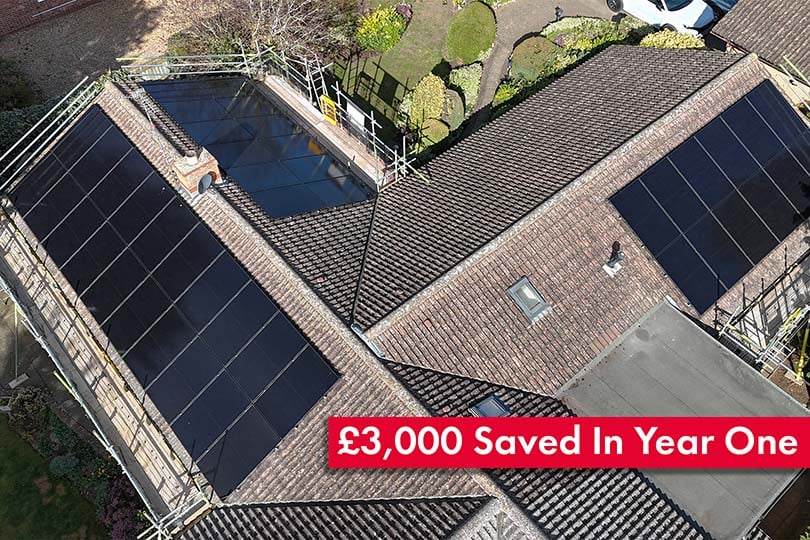
Before installation, the household's annual electricity cost sat around £4,200, calculated against current tariff rates. Left unchecked, and assuming the long-run UK average electricity inflation rate of 7.2% (based on 2000 to 2022 data), that bill was projected to climb to over £22,000 a year by year 25, with a cumulative spend north of £275,000 across the same period.
The client's electricity usage had recently increased following the installation of a heat pump, and his goal was straightforward: bring the bill down while still getting a strong rate of return on the investment. That combination of a high, rising usage figure and a return-driven customer shaped every design decision that followed.
The solution: sizing generation to usage, not roof space
Spirit Energy's in-house design team started by modelling the household's electricity consumption over the following year, then worked backwards from that figure to decide how much generation the system needed to produce. On most residential roofs, available space is the limiting factor and the answer is simply to fit as many panels as will go on. Here, the roof was large enough that the opposite was true: the design team could work out the ideal number of panels first and then choose where to put them.
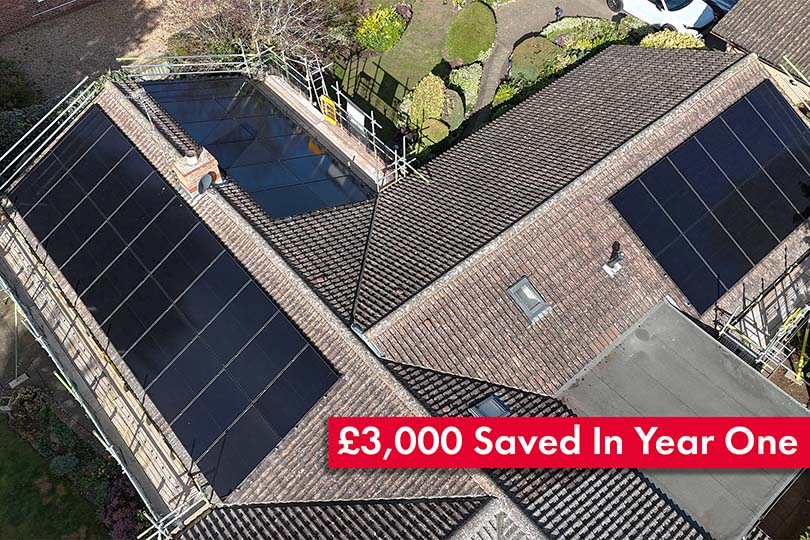
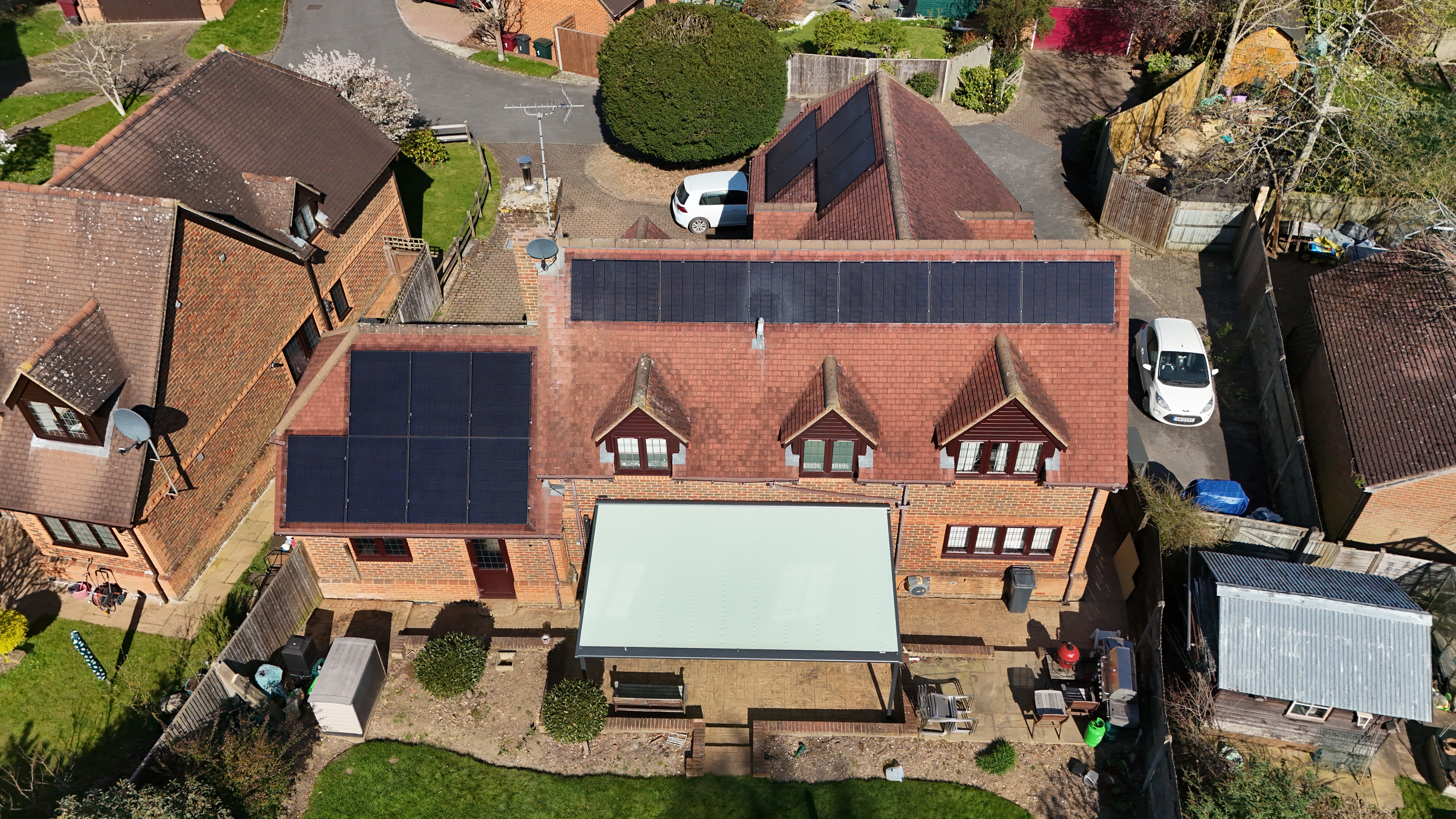
The result was 44 LONGi 490W mono all-black panels split across three roof faces, facing south, west, and east, giving a steady, even spread of generation across the day rather than a single sharp peak at midday. The panels were deliberately grouped to one side of the available roof space rather than spread across the middle, a decision that keeps the layout expandable: if more panels are added later, they can go straight in alongside the existing array instead of working around it. Mounting was done with K2 Tile fixings for a concrete tile roof, with pigeon protection mesh included as standard.
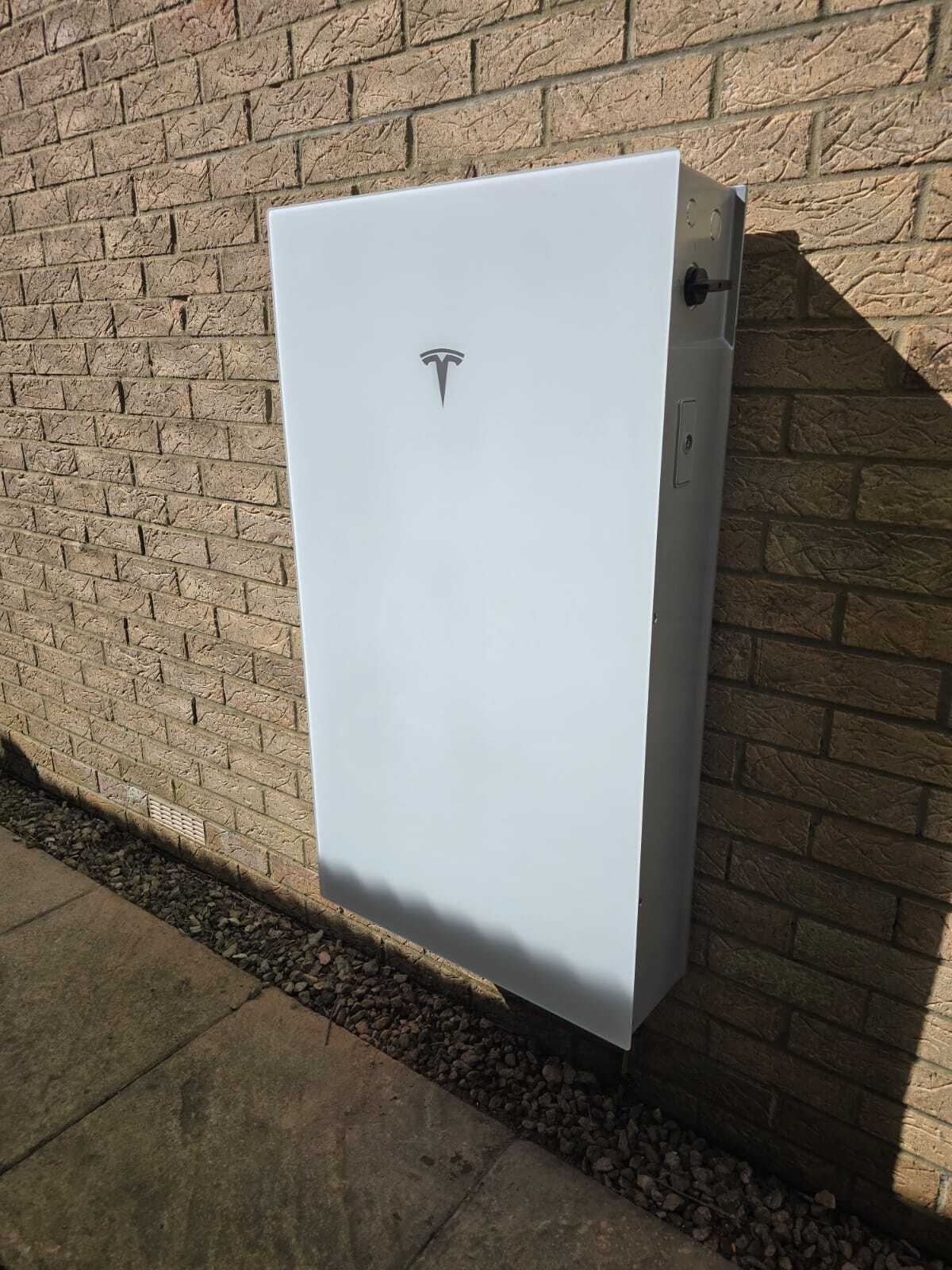
Storage came from two Tesla Powerwall 3 units, giving 27 kWh of usable capacity, mounted on an external wall with the Tesla Backup Gateway 2 sited internally next to the incoming supply. The battery capacity here is slightly undersized relative to the household's electricity consumption, and that was a deliberate call. Battery storage is the most expensive part of a system, and it only earns its keep if it's cycling fully, ideally once a day. Oversizing it means paying for capacity that sits idle. Spirit Energy's standard approach in cases like this is to size conservatively at the outset, then review real world usage data with the client after a year in service to decide whether adding further storage is a sound investment, since the system is installed in a way that makes expanding it later straightforward.
Two Tesla Wall Connectors were fitted for EV charging. The Powerwalls charge overnight from an off-peak tariff and store excess solar generation, with Tesla's own algorithm forecasting weather and household consumption a day ahead to decide when to charge and discharge for maximum savings. As part of the installation, the household switched to the Octopus Go Fixed Rate tariff, a change that Spirit Energy's modelling accounts for directly, since the tariff choice materially affects how much value the battery adds through off-peak charging.
The financial outcome
The modelled first year savings came to £4,912, made up of £3,109 in reduced bills and £1,803 in export income. Projected across 25 years, that becomes £187,557 in total savings, with a payback period of 5 years and an investment yield (IRR) of 23.7%. Net present value over the same period is £100,799, meaning that is what the system is worth today, in today's money, once future cashflows are accounted for.
The system was modelled against three electricity price inflation scenarios: at 3% inflation, 25 year savings still reach £135,284 with a 5 year payback and a 21% yield. At 10% inflation, savings rise to £246,003 with a 26% yield. In every scenario tested, payback held at 5 years. The average expected cost of electricity over the next 15 years falls to 13.7p per kWh with the system installed, against 48.4p per kWh without it.
The household now meets 36% of its electricity needs independently of the grid, with the array generating 17,384 kWh annually against a usage of 14,886 kWh.
The environmental outcome
Solar generation of this scale offsets an estimated 3,477 kg of CO2 per year, based on a standard 0.2 kg CO2 per kWh generated. Over the lifetime of the system, that is the equivalent of planting 1,663 trees, or offsetting 705 flights from London to New York. On an annual basis, it matches the CO2 output of an average family petrol car driving 14,731 miles.
What it means
A roof that once did nothing but keep the rain out is now generating power, storing it, and cutting a fixed cost down to a fraction of its former size. The panels carry a 25 year product warranty and the batteries an all-inclusive 10 year warranty with 80% retained capacity guaranteed, so the numbers above are not a one year snapshot. They are a quarter century of ownership, sized to the household's actual usage rather than just the roof, and built with room to expand once real world data confirms it's worth doing so.


.jpeg)