


The Challenge
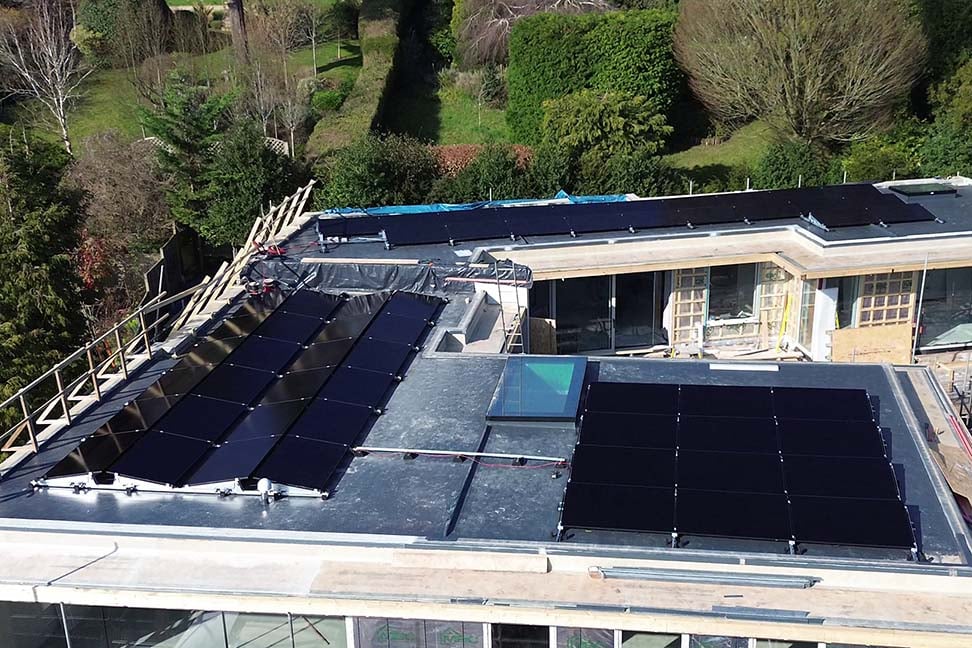
This customer's new build in Surrey presented a straightforward brief but a genuinely complex design task. The house had a large flat roof with the capacity to support a substantial solar installation, and the household's annual electricity demand of 10,000 kWh, combined with an EV to charge, meant that a well-designed system could cover a significant proportion of that demand. The question was how to get the most generation out of the available roof space.
Unlike a pitched roof, which fixes the orientation of every panel from the moment the building is designed, a flat roof offers a choice. South-facing arrays maximise midday output. East-west arrays spread generation more evenly across the day and allow tighter row spacing, meaning more panels can typically fit. Neither approach is universally better. The right answer depends on the specific roof geometry, the household's consumption pattern, and which layout produces the highest total annual yield.
The roof also needed to carry the additional structural load of a ballasted mounting system across multiple array sections, each with different orientations and wind exposure characteristics. That required careful load calculation and a structural survey before installation could begin.
The Solution
Spirit Energy modelled both a single-orientation and a hybrid layout and landed on a combination of the two. Twenty-four panels were installed in an east-west formation and 34 in a south or near-south facing orientation, split across four discrete arrays. That specific arrangement — rather than defaulting to all panels facing one direction — was what extracted the most annual generation from this roof.
All 58 panels are AIKO 480W mono all-black modules, mounted on ValkPro+ L10 ballasted frames. The system is entirely non-penetrative: no fixings pass through the waterproof roof membrane, leaving it completely intact. Ballast distribution was calculated using the manufacturer's software before installation, with loading concentrated at the edges and corners where wind uplift is greatest.
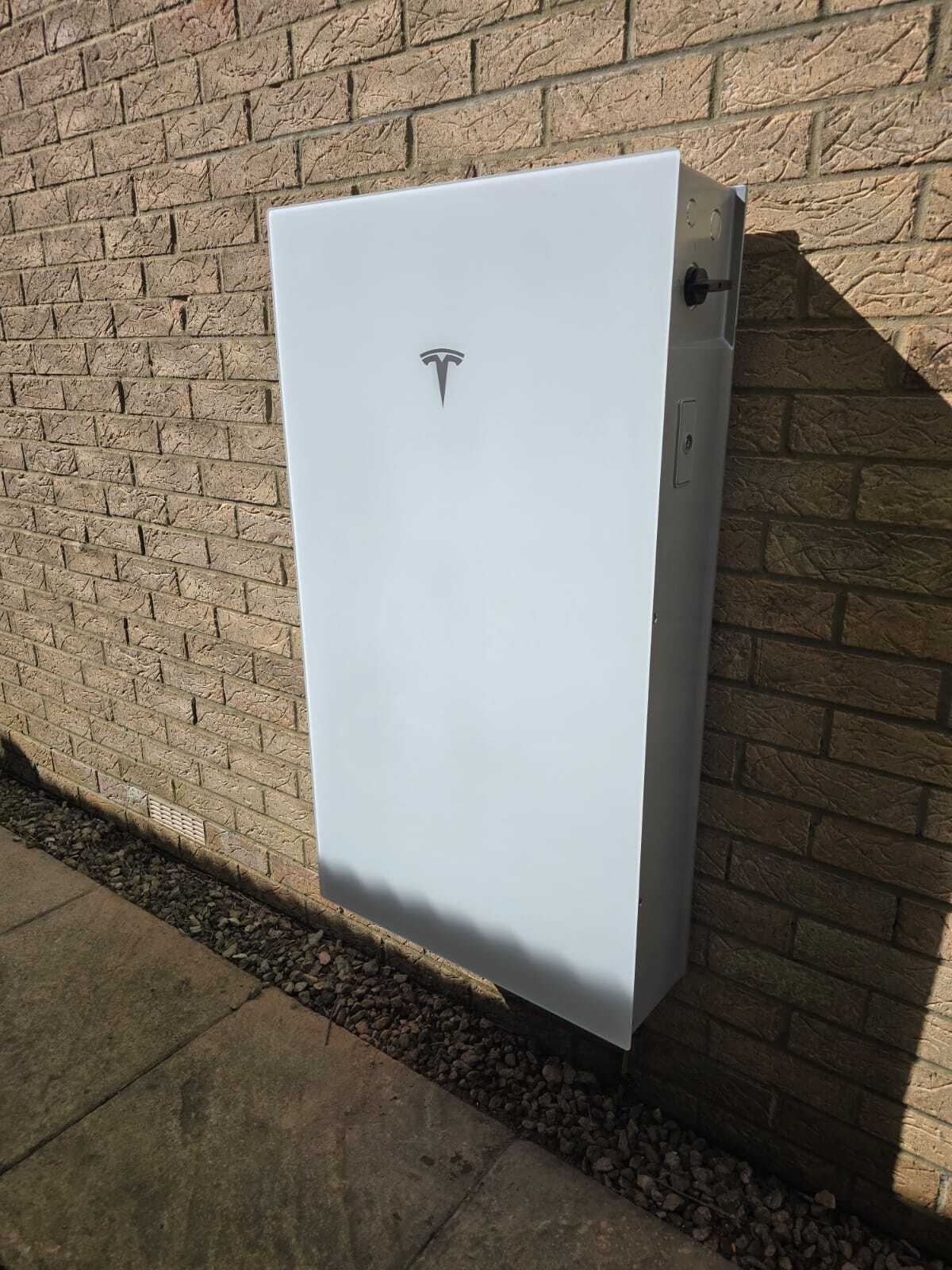
With 27.84 kWp of generation capacity producing a forecast 21,415 kWh per year against a 10,000 kWh household demand, a large battery was essential to make use of the significant daily surplus rather than export it all at a low rate. Two Tesla Powerwall 3 units and one Expansion Pack give 40.5 kWh of usable storage — enough to absorb high-generation days and cover overnight demand without drawing from the grid at peak rates. A 7 kW tethered Zappi EV charger completes the system, allowing the car to be charged directly from solar generation during the day.
System Performance and Energy Usage
Modelling shows that electricity generated by the system is used in four main ways:
- Solar used directly in the home
- Solar stored in the battery for later use
- Off-peak grid charging when advantageous
- Export of surplus electricity to the grid
Across the year, the property is forecast to reach 83% grid electricity independence. This reflects the proportion of annual electricity demand that can be supplied without importing from the grid at standard rates. The model forecasts that approximately 42% of solar generation is consumed on site, with the remainder exported when generation exceeds demand and battery capacity.
Typical daily solar generation (seasonal averages) is forecast as:
- Winter: 21.07 kWh per day
- Spring: 48.54 kWh per day
- Summer: 66.64 kWh per day
- Autumn: 43.66 kWh per day
Seasonal export behaviour is driven by the mismatch between peak daytime generation and household demand. In higher-generation periods, the system is expected to export significant volumes of electricity once on-site and battery requirements have been met.
Financial Savings and Long-Term Benefits
Over a 25-year forecast period, the system is projected to deliver total electricity savings of £149,781.
In year one, total savings are forecast at approximately £3,994. This is made up of:
- Expected bill savings: £2,564
- Expected export income: £1,431
Average electricity costs over the next 15 years are expected to reduce from 48.8 p/kWh (without solar and battery) to 20.3 p/kWh (with the system installed), based on the modelling assumptions.
The financial model reports a positive net present value of £61,732 over 25 years, using a 3% discount rate and a 10% battery round-trip loss assumption. Payback is forecast at 9 years, with an investment yield (IRR) of 12.7%.
Environmental Impact
Based on the forecast generation, the system offsets an estimated 4,283 kg of CO2 per year.
This annual carbon saving is presented as equivalent to:
- An average family petrol car's CO2 emissions for 18,147 miles per year
Over the system lifetime, the model equates the carbon benefit to:
- Planting 2,049 trees
- 868 flights from London to New York
Conclusion
This installation demonstrates what becomes possible when a large flat roof is designed properly rather than simply filled. The hybrid east-west and south-facing layout, sized to 27.84 kWp across 58 panels, produces significantly more annual generation than a single-orientation approach would have achieved on this roof. Paired with 40.5 kWh of Tesla battery storage and the Octopus Flux tariff, the system is forecast to cover 83% of the household's electricity demand without grid imports at standard rates, delivering £149,781 in projected savings over 25 years alongside a meaningful and measurable reduction in carbon emissions.


.jpeg)