

TL;DR
The UK Government has announced up to £1 billion of investment into community and local energy projects under its “Local Power Plan”, delivered via Great British Energy. The stated aim is to help communities and local authorities own and benefit from clean power projects, with funding expected to be delivered through grants and loans, and further scheme detail due later. (GOV.UK)
If you work with schools, councils, clubs, charities, community groups, or you own commercial property that could host solar, this is not just policy noise. This is a potential unlock for projects that previously stalled because capital was the blocker, or because the business case relied on a structure like a Power Purchase Agreement (PPA) and the counterparty needed more support to get comfortable. It also puts community solar funding firmly on the map again, but this time with a much bigger number behind it. (The Guardian)
What Is the £1bn Community Energy Fund and Where Is It Coming From?
The £1bn sits within the Government’s Local Power Plan and is backed by Great British Energy, the state-owned body set up to invest in and support clean energy projects. The announcement frames this as community and local energy investment, with the intention that communities and local authorities can develop and own projects so value stays local rather than flowing out to large corporates.
There are two important implications for delivery. First, this is not being positioned as a single, one-size-fits-all grant pot. It is more likely to become a set of programmes with different eligibility rules and funding mechanisms. Second, because it is routed through Great British Energy, you should expect a strong focus on “can this project actually be delivered”, not just “does it sound good on paper”.
Who Qualifies for Community Energy Funding in the UK?
The government announcement and sector commentary point to support being targeted at community energy groups and local authorities, with schemes expected to roll out later. In practice, that usually means incorporated community organisations (for example community benefit societies, co-ops, CICs, and charities) plus public sector bodies like councils and public trusts.
Where commercial organisations come into this is typically structural. A private organisation may be eligible if it is part of a community-led vehicle, a public-private partnership, or a delivery model where the community has ownership, governance rights, or a defined benefit stream. If you are a commercial property owner, the simplest way to think about it is that your roof or site can become part of a fundable community project if the ownership and benefit model fits the scheme criteria.
What Types of Projects Are Likely to Be Supported?
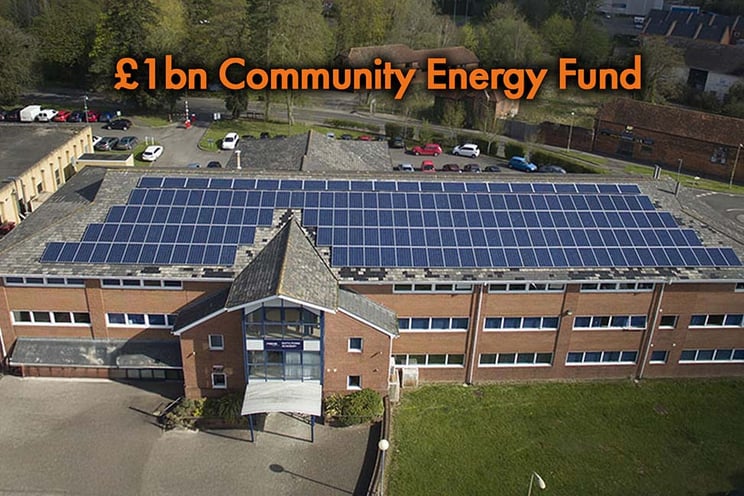
The public statements around the plan talk about locally owned clean energy projects and give examples such as installing solar on public buildings like libraries, alongside other renewable generation types. That points strongly towards straightforward rooftop solar projects across public and community estates, as well as enabling works that make those projects viable. (Reuters)
Expect strong interest in schemes that are replicable across portfolios. For example, a local authority programme across multiple buildings, a schools or academy trust rollout, or a community energy group delivering a consistent model across several community assets. Battery storage may also feature where it supports resilience and improves self-consumption, but early waves typically favour faster-to-deploy generation, because it shows impact sooner and builds momentum.
What It Means for Schools
Schools are often an excellent fit for community solar funding because they combine suitable roof space, predictable usage, and a clear public benefit story. In many cases, the best savings come from using solar on-site during the day, which aligns well with school operating hours. On top of that, schools and trusts usually have strong reasons to pursue public sector solar funding, including budget stability and emissions reduction reporting.
What It Means for Councils and the Public Sector Estate
For councils, the opportunity is bigger than “panels on the town hall”. The council estate often includes leisure centres, offices, depots, libraries, care-related buildings, and other high-usage sites that can make solar pay back quickly even without support. The Local Power Plan framing explicitly references local authority involvement, and the rationale is to keep benefit local, which fits very naturally with council-led programmes.
If you are planning a council programme, the gating items are rarely enthusiasm. They are usually roof condition, structural suitability, grid constraints, and internal delivery capacity. Funding helps, but it does not remove the need for a proper feasibility process and a realistic grid strategy.
What It Means for Clubs, Community Buildings, and Charities
Clubs and charities often have large, underused roofs and rising electricity costs that directly affect their ability to deliver services. The policy intention behind community energy is to let these organisations keep more value in the local area. That could mean lowering operating costs, creating an income stream, or using project surplus to fund local priorities.
For many community organisations, the difference here is that funding can move solar from “good idea” to “doable this year”, especially where an organisation does not want to take on debt or cannot justify tying up reserves.
How to Prepare Now So You Are Ready When Schemes Open
The most useful thing you can do before the detailed prospectus lands is make your project “decision-ready”. That means confirming roof condition and remaining lifespan, getting early structural comfort where required, understanding your half-hourly demand profile, and modelling how much solar would be self-consumed on-site versus exported. It also means doing an early sense-check on grid connection constraints, because DNO limitations can still dictate system sizing and timelines regardless of funding.
If you are a community group or a public body, you will also want clarity on delivery structure. Who owns the asset, who receives the benefit, who is responsible for maintenance, and what happens if the building changes hands. Those questions are exactly where projects often stall, so answering them early is a competitive advantage.
We Can Help You Assess Eligibility and Build the Business Case
If you’re a community group, a school or trust, a council, a club, or a commercial property owner, we can help assess eligibility and model what a funded solar project could look like. We can run a feasibility review, advise on delivery structures that fit community ownership models, produce a technical design, manage the DNO process, and deliver the installation through to commissioning. If you want to explore community energy funding UK opportunities, community solar funding routes, or public sector solar funding options, get in touch and we will give you a clear next step.

FAQs: Community Energy Funding UK and Community Solar Funding
Will the £1bn fund pay for solar panels outright?
The announcement indicates funding will be delivered through grants and loans, with scheme details to follow, so the exact coverage will depend on the programme rules when launched.
Are private businesses eligible for community energy funding?
The emphasis is on community energy groups and local authorities, but private organisations can sometimes participate where the ownership and benefit model is structured around community outcomes rather than pure private gain.
What buildings are most likely to benefit first? Public and community buildings that are easy to deliver at scale, such as libraries and other council assets, are explicitly referenced in reporting around the plan, and similar buildings like schools and leisure centres are natural fits.
When will schemes open? Reporting and government comms suggest specific schemes will roll out later this year, with more detail expected in a prospectus or programme guidance.