


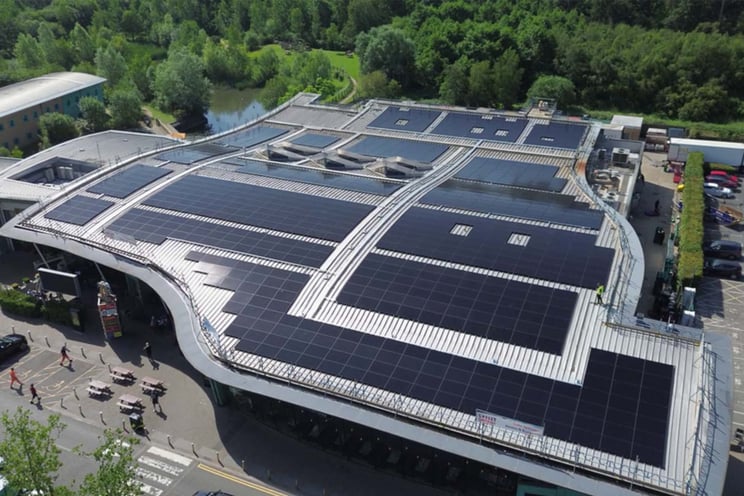
Beaconsfield Services on the M40 has 840 solar panels on its roof, forecast to save the business around £67,000 in the first year alone. That single roof illustrates why motorway service stations, among the most electricity-hungry buildings in the UK, are also among the best candidates for commercial solar. The reason comes down to how relentlessly these sites use power, and how much of that demand solar can offset directly.
Why service stations use so much electricity
A motorway service station never closes. Lighting, refrigeration and catering run continuously, EV chargers draw power whenever a car is plugged in, and kitchens are often active from the early hours. Across a year, a site like this can use more electricity than several hundred homes combined. Almost none of that demand is seasonal or occasional. It is constant, which matters enormously for the economics of solar.
Why commercial electricity costs keep rising
UK businesses have limited ways to shield themselves from an electricity bill that keeps climbing. The average electricity unit rate under Ofgem's price cap rose to 26.1p per kWh from July 2026, and analysts expect continued upward pressure on commercial rates through the rest of the year. A growing share of that cost has nothing to do with wholesale gas. Network investment, in particular Transmission Network Use of System charges tied to National Grid's modernisation programme, is forecast to make up close to 60% of a typical business electricity bill by 2026. That cost is structural and shows no sign of easing. A business generating its own electricity removes a portion of its bill from that exposure entirely.
How solar actually saves a service station money
Every unit of electricity a solar system generates and the building uses immediately is a unit that does not need to be bought from the grid at full commercial rate. Anything the building does not use gets exported instead, typically earning around a third of the price of the electricity it displaces. That difference is why the best commercial solar sites are the ones that consume most of what they generate rather than exporting the surplus.
Most commercial buildings self-consume between 60% and 80% of their solar generation. At Cobham Services on the M25, Spirit Energy's modelling showed 96%, among the highest self-consumption rates in the portfolio. A site that never closes, and where every kilowatt-hour generated is likely to be used on-site rather than sold back at a fraction of the price, is close to the ideal case for commercial solar.
The Beaconsfield example
Beaconsfield Services, operated by Extra MSA, installed 840 panels generating an estimated 350,000 units of electricity a year, enough to cover the annual usage of around 110 homes. The system is forecast to save the business roughly £67,000 in year one and pay for itself within 4 years, with an expected 25 years of generation to follow. Spirit Energy will publish a full case study on this project separately, but the headline figures already demonstrate the scale of saving available on a high-demand commercial roof.
How businesses pay for a system this size
There are three common ways UK businesses fund a commercial solar installation. Outright purchase, the route Extra MSA chose for Beaconsfield, gives the business full ownership and the strongest long-term return. Financed installations are structured so the reduced electricity bill plus the loan repayment still comes in below the original bill from year one, meaning the business is cash flow positive immediately while the system pays itself off.
Installing solar on a site that never sleeps
A service station cannot close for a fortnight while scaffolding goes up. Deliveries to the kitchens run around the clock, and tens of thousands of vehicles pass through every week. At Cobham Services, Spirit Energy erected the scaffolding overnight and scheduled all panel deliveries around the existing slots for the site's restaurants, so loading bays and kitchen access were never blocked. Getting a large commercial solar installation onto a live, 24/7 site is as much a logistics exercise as an engineering one, and it is where a contractor's in-house project management experience shows.
Why should I put solar panels on my service station
Not every commercial roof suits solar equally well. The strongest returns come from buildings that combine a large, usable roof area with continuous, predictable, on-site electricity demand, because every unit generated and used directly is worth roughly three times what the same unit earns on export. Service stations tend to have both.
A typical services building has thousands of square metres of largely unshaded roof, split across the main building and any adjoining retail units, and unlike an office or a shop, that demand doesn't drop to near zero overnight or at weekends. Refrigeration, lighting, EV chargers and catering equipment keep pulling power around the clock, which is exactly the load profile that lets a system like Beaconsfield's reach the high self-consumption rates seen at Cobham.