


No UK hotel of ordinary density runs on solar power alone, and the reason is storeys rather than sunshine. Roof area per bedroom is the binding constraint: a two-storey country house hotel has twice the roof per bedroom of a four-storey city hotel, so it can cover roughly twice as much of its electricity. Realistic figures run from about a tenth of annual electricity on a tall urban building to about half on a low, sprawling site.
How much of a hotel's electricity can solar actually cover?
Start with floor area. The published UK hotel benchmarks assume around 58 square metres of gross internal area per bedroom, which covers the room plus its share of corridors, kitchens, function space and plant. Typical electricity consumption sits between 105 kWh per square metre (the CIBSE TM46 benchmark used for Display Energy Certificates) and 140 to 150 kWh per square metre for business, holiday and luxury hotels under the older ECG 036 figures, with more on top for air conditioning and a leisure pool. A single bedroom's share of annual electricity is therefore somewhere between 6,000 and 8,700 kWh.
Now the roof. A modern commercial module produces around 440W in about two square metres. Once plant, access walkways, edge zones and the gaps needed to stop one row shading the next are taken out, roughly half a flat roof ends up under panel. At around 950 kWh per kWp per year in southern England, that comes to approximately 100 kWh a year for every square metre of roof.
Divide that floor area by the number of storeys to see the available roof space per room:
- Two storeys: about 29 square metres of roof per bedroom, covering roughly a third to a half of that bedroom's electricity
- Four storeys: about 14 square metres, covering roughly a fifth to a quarter
- Six storeys: about 10 square metres, covering roughly a tenth to a sixth
Two factors push real-world performance lower still:
- Load mismatch: Gross generation doesn't equal self-consumption; unmatched midday generation is exported rather than used on-site.
- The thermal gap: Electricity is only part of the bill. Hotels consume roughly three times more energy in gas and heat ($330kWh/m2)than in power ($105kWh/m2), which standard PV leaves untouched.
The decision rule is simple. If a quotation promises 60 to 80 per cent self-sufficiency, ask how many storeys the building has and how many square metres of roof have been measured. The percentage should fall out of the roof plan, not out of a brochure.
What 217kWp looks like on a real hotel
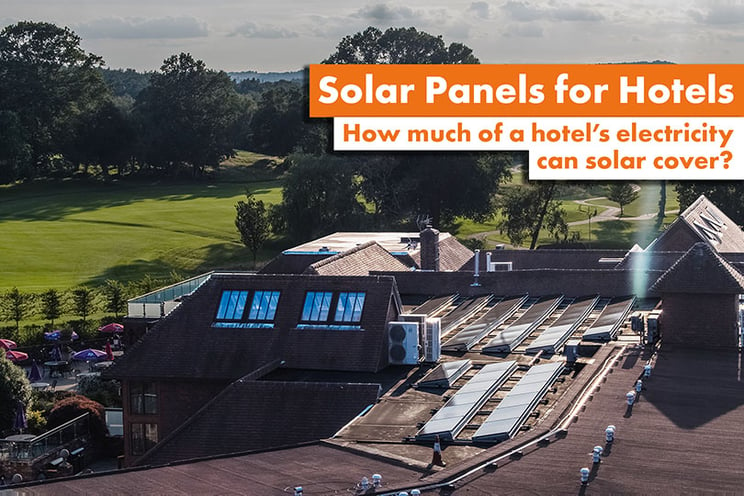
Spirit Energy installed 630 JA Solar 345W panels across three roofs at Old Thorns Hotel and Golf Course in Liphook, Hampshire, running into five inverters for a total of 217kWp. The system is expected to generate 208,419 kWh a year, which works out at 960 kWh per kWp and confirms the 950 assumption used above.
Old Thorns has more than 150 rooms alongside self-catering apartments, a spa and a golf course. At benchmark consumption for a resort of that size, 208,419 kWh is a meaningful minority of the site's electricity rather than most of it, and that is what a large, well-designed hotel array looks like in practice. It is also, at any plausible commercial unit rate, tens of thousands of pounds of avoided purchase every year for 25 years. The system was funded through a solar power purchase agreement, so it required no capital from the hotel.
Judge an array on pounds avoided per year against capital committed, not on a self-sufficiency percentage.
Where hotels do better than most commercial buildings
Occupancy peaks in summer, which is when generation peaks. That alignment is rarer than it sounds: schools sit empty through August, and offices thin out through the same weeks. A hotel is fullest when its roof is most productive.
Kitchens, laundry and ventilation also give a hotel a genuine daytime base load seven days a week, so the weekend export problem that undermines the return on an office array does not arise. High self-consumption, not high generation, is what determines whether commercial solar pays, and hotels have a structurally good self-consumption profile.
What actually stops hotel solar projects
Listed status and conservation areas stop more hotel projects across England than any technical factor. A large share of UK hotel stock sits in historic buildings, and panels visible from a public highway on a listed building are a planning question before they are an engineering one.
Roof condition stops the next tranche. A 25-year asset should not be fixed to a covering with six years of life left in it, because taking an array off and putting it back costs a significant share of what it cost to install. Commission the roof survey before the solar design, not after.
Then the grid. On a constrained urban network the DNO may permit the generation only with an export limitation device, which caps what the array can send out and changes the modelling. And there is the operational cost nobody quotes for: scaffolding, noise, and rooms that cannot be sold while work is overhead. Hotel installations should be programmed around occupancy and pushed into shoulder season.
How much can my hotel save with solar
The useful question is not whether a hotel can run on solar power. It is how many kilowatt hours the roof can produce, how many of those the hotel will consume itself, and what those avoided units are worth against the capital.
All three of those figures come out of two documents. A roof plan with plant, rooflights and access routes marked gives the genuinely usable area rather than the gross footprint, and twelve months of half-hourly meter data gives the demand shape the array has to match. Anyone quoting without both is estimating. Ask for the self-consumption figure alongside the generation figure, because the gap between the two is where an oversized system quietly loses its return.
Spirit Energy designs and installs solar panels for hotels with in-house design and installation teams. Send us those two documents at commercial@spiritenergy.co.uk or give us a call, and we will produce a generation and self-consumption model for the site.