

TL;DR
Care homes have one of the most consistent and unavoidable energy profiles of any building in the UK. Heating runs all day. Lighting runs all night. Medical equipment does not pause. Staff are on site around the clock. There is no quiet period where you can simply switch things off and wait for cheaper rates.
That is why energy has become one of the most urgent cost pressures facing care home operators, and why solar panels have moved from being a peripheral consideration to a serious financial decision.
Why Energy Costs Hit Care Homes Harder Than Other Businesses
Some businesses have flexibility in how and when they use electricity. Care homes do not.
UK electricity prices have risen sharply over the past decade, driven by wholesale gas markets, grid infrastructure costs, and geopolitical instability. Between 2004 and 2024, electricity prices increased at an average rate of around 7% per year. That is a structural trend.
For a business that cannot reduce consumption, that trend translates directly into reduced margins, year after year, with no obvious way to respond.
The problem is not just the current price. It is that the price is outside your control entirely. Care home operators are skilled at managing staffing ratios, occupancy, and compliance costs. But electricity pricing is set by wholesale markets in ways that have nothing to do with how efficiently you run your building.
Solar does not solve all of that. But it does solve a significant part of it.
Solar, Sustainability, and What the UK's 2030 Target Means for Care Homes
The UK government's Clean Power 2030 Action Plan sets a target of 45 to 47 GW of installed solar capacity by the end of this decade, up from 21.5 GW today. That means roughly doubling the entire solar capacity the UK has built over the past 15 years, in just five. A significant portion of that growth needs to come from commercial rooftops. Research by UCL's Energy Institute found that all suitable roof space and car parks across the UK could generate up to 117 GW of solar electricity, nearly three times the government's 2030 solar target on its own.
The financial case for solar stands on its own, but for care home operators there is a second dimension worth considering: regulatory and ESG pressure is moving in one direction only. The UK government has committed to decarbonising the electricity grid by 2030, and the broader net zero target for 2050 sits behind an increasing volume of energy efficiency legislation that is already working its way through the commercial property sector. Care homes with poor EPC ratings are likely to face tighter requirements in the coming years, and solar directly improves a building's energy performance rating by reducing reliance on purchased grid electricity.
What Solar Actually Does for a Care Home
A solar panel system generates electricity on-site during daylight hours. That electricity is used directly within the building, reducing the amount you need to purchase from the grid.
For a care home, the key question is always: how much of the solar generation will we actually use ourselves?
The answer, for most care homes, is the majority of it. Daytime energy usage in a care home is high and consistent. Kitchens, laundry, communal areas, administration, and medical equipment all run continuously. Unlike a typical office building, which might be largely empty on weekends, a care home operates at near-full capacity every day of the year.
This is one of the reasons care homes are particularly well suited to solar. The profile of energy use closely matches the profile of solar generation. That means a large proportion of what the panels produce is consumed immediately on-site, at its full value, rather than being exported to the grid at a lower rate.
What Are the Realistic Savings?
This depends on the size of the system and the energy consumption of the care home, but the financial case for commercial solar is well established.
A well-sized system for a care home typically delivers a payback period of 4 to 7 years. After that, the electricity it generates is effectively free for the remainder of the system's life, which is typically 25 years or more.
The savings compound over time. A system installed today, at today's costs, provides price protection against whatever happens to grid electricity prices over the next two to three decades. Given the trajectory of the past twenty years, that protection has real value.
It is worth being clear about the alternative. Doing nothing means remaining fully exposed to grid electricity prices for the foreseeable future. That is not a neutral position. It is an active decision to carry a risk that, for most care homes, is already causing financial pain.
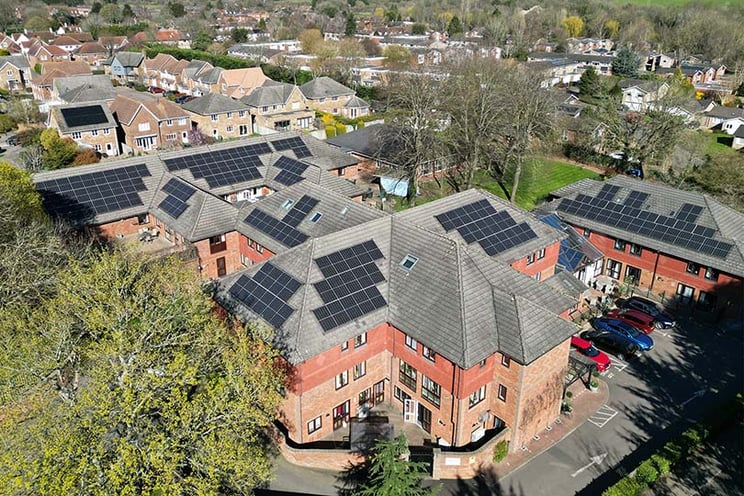
| Site delivered by Spirit Energy | Payback Period | Internal Rate of Return (IRR) |
| St. Luke's (B&M Care Homes) | 6 years | 20% |
| Wentworth Lodge (B&M Care Homes) | 6 years | 19% |
| Osbourne Court (B&M Care Homes) | 5 years | 24% |
Can Care Homes Export Electricity Back to the Grid?
Yes, through the Smart Export Guarantee. Any electricity generated but not used on-site can be exported and paid for by your energy supplier.
However, export rates are considerably lower than the cost of buying electricity. The financial case for solar in a care home is built on self-consumption, not export. Export is a useful secondary benefit, not the primary one. A well-designed system is sized to match your consumption, not to maximise export.
What About Funding the Installation?
The upfront cost of a commercial solar installation is the most common reason care homes delay the decision. It is a reasonable concern, but there are options beyond simply paying for the system outright.
Outright purchase gives you the strongest long-term return. You own the asset, you capture all the savings, and the system adds value to the property.
Power Purchase Agreements (PPAs) allow a third party to fund and install the system at no upfront cost to you. You then buy the electricity it generates at a rate below the grid price. You save from day one without capital expenditure, though the long-term return is lower than ownership.
Finance and loans allow you to spread the cost over time. If the monthly repayments are lower than the monthly savings, the system pays for itself as it goes.
Is Solar Worth It for Care Homes?
For the majority of care homes in the UK, yes.
The combination of high, consistent energy use, large roof space, and no ability to reduce consumption makes care homes one of the strongest use cases for commercial solar. The financial return is real, the payback period is clear, and the long-term benefit extends across decades.
More importantly, solar converts one of your largest and least controllable costs into something predictable. For operators managing tight margins in a heavily regulated sector, that shift from uncertainty to stability is worth something beyond the numbers alone.
If energy is already one of your most significant operating costs, the question is not really whether solar makes sense. It is whether you can afford to keep going without it.
Thinking about solar for your care home? Spirit Energy has been installing commercial solar systems since 2010. We are partnered with B&M Care to install on 23 of their sites. Get in touch for a free, bespoke assessment of what a system could save your site.