


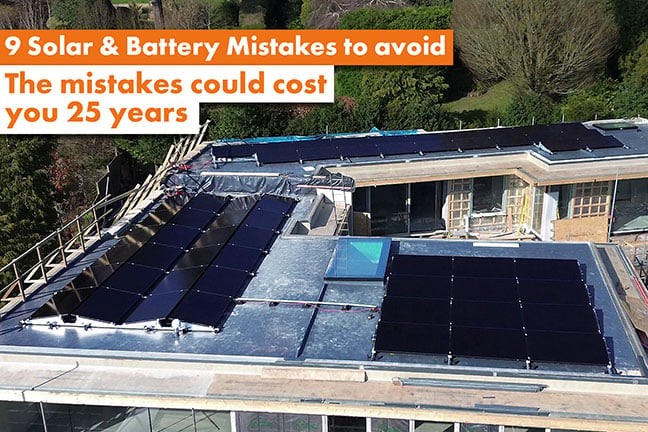
These nine mistakes account for most of the money lost on a UK solar and battery installation, and nearly all of them are made at the quotation stage rather than on the roof. The most expensive is fitting fewer panels to bring the price of a quote down, because the panels themselves are only around 5 to 10% of the total cost of the job. Spirit Energy has designed and installed these systems since 2010, and the same errors still turn up in the quotes homeowners bring in for a second opinion.
1. Is it worth removing panels to lower the price of a solar quote?
No. The panels are the cheap part of the job, so removing them saves very little and costs a great deal.
Labour, scaffolding, the battery and the inverter make up most of the cost, and almost all of that stays the same whether you half fill the roof or cover it. Taking three or four panels off a design to save a couple of hundred pounds cuts the part of the system that generates the income, on roof space you are already paying to scaffold and work on. You give up 25 years of output to save a one off amount.
Panel choice does the same thing more quietly. Octopus Energy states that all its solar packages use 455W panels measuring 1.7m by 1.1m. Panels in a similar footprint are now available at 490W to 500W, which is roughly 8 to 10% more generation from the same roof area, the same mounting kit and the same day's labour.
Nine times out of ten the right answer is to fill the viable roof space. Ask what wattage panel is in the quote and what its dimensions are, because two quotes with the same panel count can differ by 10% in output.
2. Should you take the cheapest solar and battery quote?
Not before you work out what the more expensive quote includes that the cheap one does not.
There is almost always a reason for the difference, and the useful question is not why the expensive one costs more. Some of that difference is visible: better panels, a better battery, a longer warranty. Some of it is not. A structural survey that confirms the roof can carry the weight. Mounting specified for your roof covering rather than a generic kit. Scaffolding with proper edge protection rather than a ladder on the day.
Corners cut on the install do not show up on day one. They show up in years three to ten, when the remediation cost exceeds whatever was saved at the start.
3. Should you design a solar system around selling electricity to the grid?
No. Export income belongs in the model as upside, not as the foundation of it.
The rate you are paid for exported electricity is set by your supplier, and it can go down. Outgoing Octopus, one of the more widely used export tariffs, paid 15p per kWh in September 2022 before dropping to 12p on 1 March 2026.
What you avoid paying is worth far more than what you are paid. Under the Ofgem price cap for 1 July to 30 September 2026, importing electricity costs 26.11p per kWh. Every unit you use in your own home is therefore worth roughly twice a unit you sell.
The split shows up clearly in real modelling. On a 10.56 kWp system with 27 kWh of storage that Spirit Energy designed in East Surrey, year one savings were forecast at £2,710, of which £580 came from export. Around a fifth of the value came from the part the household had least control over.
Time of use export tariffs can pay considerably more during evening peak windows if you have a battery, so export is not worthless. But as more homes install solar and storage, the pressure on those rates is downwards rather than up.
4. What size solar battery gives the best payback?
The size that fully charges and fully discharges into the house at least once a day.
The battery is usually the most expensive single item in the project, and it earns its money by charging cheaply, from your own solar or an off peak rate, then running the house through the expensive hours.
If it is bigger than the house can actually consume during the peak rate window, that surplus capacity does not sit there neutral. It drags down the return on the capacity that is working.
Modular systems make this easy to get right. A Tesla Powerwall 3 or a Sigenergy SigenStor can take added storage later without disturbing what is already installed. Sizing slightly under and adding a year later, once you have your own consumption data, usually beats guessing high at the outset and paying for capacity you may never cycle.
5. Are solar optimisers, micro inverters and hot water diverters worth it?
Only on a roof with a genuine shading problem, or where your export rate has fallen below your gas rate.
Micro inverters and power optimisers are sold on shade. Where there is real shade, a chimney, a neighbouring building, a mature tree, letting each panel work independently does make a measurable difference and is often the right call.
On a clean, unobstructed roof it is a premium for a problem you do not have. There is also a maintenance cost that rarely gets discussed. The warranties are long, typically 25 years, but they usually cover the unit and a contribution towards labour rather than the full cost of getting it back. The units sit behind the panels, and panels are railed together, so replacing one in the middle of an array means working in from the end. Add scaffolding and a failed unit can wipe out years of extra generation.
Hot water diverters have the same problem with a different sum. Gas under the current price cap is 7.33p per kWh. If your export rate is around 12p, you are better off exporting and paying for gas. That gap did narrow on 1 July 2026, when the capped gas rate rose from 5.74p, so it is worth rechecking against your own two rates rather than assuming. Behind a well sized battery there is usually little surplus left for a diverter to work with anyway.
6. Can a solar battery charge properly in cold weather?
Yes, provided the battery heats itself. Active thermal management keeps the cells in their working temperature range regardless of what the weather is doing outside, so the battery charges at full rate through the winter.
That matters because winter is when a battery earns most of its money. Electricity is at its most expensive, the panels are generating least, and most of the value comes from charging overnight on a cheap rate and running the house through the expensive evening hours. Lithium cells charge more slowly as temperature drops, and at around 5°C or below a battery with no built in heating can struggle to take a full overnight charge.
The Tesla Powerwall 3 and the Sigenergy SigenStor both manage their own temperature, which is why they hold up through a British winter. The Powerwall 3 is rated for outdoor installation and uses its cooling and heating system to run in temperatures well below freezing. The SigenStor takes the same approach through its own thermal management. In both cases the battery is doing the work of conditioning itself, so a January cold snap does not quietly cost you the overnight charge you were counting on.
A garage or another sheltered position reduces how hard the system has to work to hold temperature, even on a battery designed to sit outside. If a quote puts a battery on an exposed external wall, ask what it does when the temperature drops and what its rated operating range actually is.
7. How long should the lead time be for a solar and battery installation?
It depends on the grid connection route. A small system requires a G98 application needs no advance permission, so a short lead time is legitimate. Anything larger needs a G99 application approved first, which usually takes 6 to 8 weeks but can sometimes be even more.
Under G98, your installer connects the system and notifies the DNO afterwards, with no wait. That route covers inverter capacity up to 3.68 kW per phase, enough for a modest array or a small battery. Above that, you need a G99 application submitted and approved before installation, so the DNO can check the local network can take the extra capacity. In Spirit Energy's experience that takes six to eight weeks, sometimes eleven.
So a four to six week turnaround is normal for a 3.68 kW system, but not for a 6 kW or 8 kW one, unless the application went in weeks ago. Spirit Energy has seen this on quotes brought in for a second opinion, with panels capable of more than the inverter will ever let through.
Ask which route your system falls under, and if it is G99, whether the application is already in.
8. Can a solar inverter be uprated if your DNO limit improves later?
Some can and some cannot, and it depends entirely on which hardware you buy.
Your DNO can restrict you in two ways. An export limit caps what you may send to the grid, and can be set in software on any inverter. A generation limit caps what the system may produce at all, and that one is a hardware question.
Some products let the generation rating be raised in software, so a better allocation later can be applied remotely with no return visit. The Powerwall 3 works this way. Others, including the Sigenergy SigenStor and Fox EVO, have the rating fixed in the hardware, so taking advantage of a higher limit means replacing the inverter.
This matters because network capacity is not static. In December 2025 Ofgem approved £28 billion of upfront network funding for the five years from April 2026, including £10.3 billion for electricity transmission across 80 projects, within a pipeline it expects to reach around £90 billion by 2031. Reapplying carries no risk, because a DNO cannot withdraw capacity it has already granted and you have already installed.
9. Should you check your roof condition before installing solar panels?
Yes, before you sign anything.
A solar array will be on the roof for 30 years or more, so the roof underneath needs at least that much life left in it.
If it does not, you end up removing the system to re roof and refitting it afterwards: scaffolding twice, labour twice, disruption twice. There is a practical wrinkle most people do not expect. Roofers will generally not work on a roof with panels on it, so lifting and refitting the array falls to your solar installer.
A good installer checks the loft as well, confirming the rafters and timbers can carry the mounting. Where the roof is borderline, re roofing first or at the same time is almost always cheaper, and an in roof system fitted while the scaffold is already up saves on both tiles and labour.
What all nine mistakes have in common
Every one of them is a decision made before anyone gets on the roof, and every one is cheap to change at that point and expensive to revisit afterwards. Panel count, battery size, inverter choice and grid connection are all settled at design stage, and they then set the return for the next 25 years. A month spent getting them right does not register against that timescale.
What turns up in second opinion quotes is rarely a bad installer. It is more often a design optimised for the quotation rather than for the quarter century that follows it.
If you have quotes in front of you and you are not sure they are comparable, Spirit Energy will review them and produce a bespoke technical proposal modelled on your roof and your actual consumption, at no cost.