


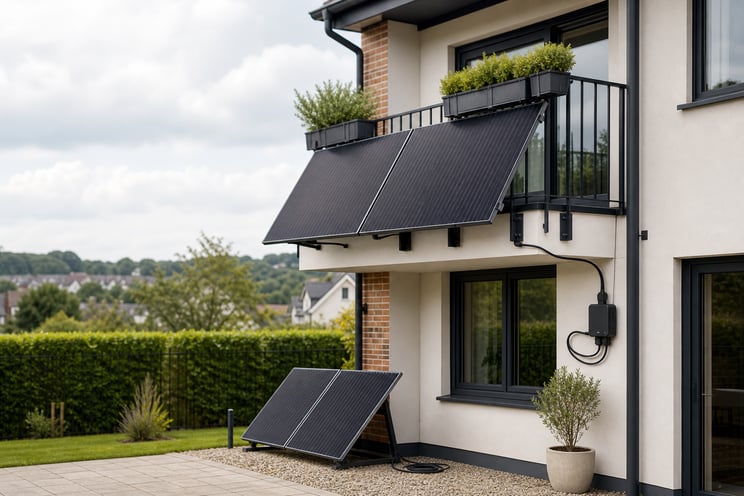
This image was AI-generated.
Plug-in solar panels up to 800W became legal to connect to a UK plug socket on 15 April 2026, and the rule allowing a certified kit to go straight into that socket without an electrician takes effect on 27 August 2026. As of today (31/07/2026), no plug-in product has actually been certified yet, so nothing branded Lidl exists on a shelf today. The numbers are worth knowing regardless: the legal maximum plug-in kit generates roughly 640 to 760 kWh a year, against around 3,400 to 3,800 kWh a year from a typical 4kWp rooftop system in southern England, a four to six times difference.
Are plug-in solar available in the UK?
On 24 March 2026, the government announced it would legalise plug-in ("balcony") solar, working with retailers including Lidl and Iceland and manufacturers including EcoFlow.
BS 7671 Amendment 4 came into force on 15 April 2026. This is the wiring regulation update that allows a small generator to connect through a normal domestic socket, addressing the specific safety question of how much reverse current a UK ring main circuit can handle.
DESNZ published the final version of its product specification on 16 July 2026. This is a government specification, not a British Standard, a distinction some of the coverage online has blurred.
The rule letting a certified kit connect through a socket becomes law on 27 August 2026 (SI 2026/848). But as of late July, the industry's own certification register listed no approved product. Until one exists, the compliant way to connect any plug-in system is still through a qualified electrician, and every system, certified or not, needs a DNO notification (G98) before it goes live. The limit for now is one device per household, not per circuit.
What's actually for sale today, through Amazon, are panel-and-battery hybrid kits such as EcoFlow's STREAM range, priced from £799 to £1,249. They don't match the government's simpler, panel-only vision, and they still need that electrician's connection.
How much electricity does a legal plug-in kit generate compared with a rooftop system?
A single 400W plug-in panel generates around 320 to 380 kWh a year in typical UK conditions. The legal maximum, an 800W two-panel kit, generates roughly 640 to 760 kWh.
A typical 4kWp rooftop system in southern England generates around 3,400 to 3,800 kWh a year, and most homes have roof space for more than 4kWp if the layout allows it.
The 800W cap exists for a reason. Above that output, the safety questions around backfeeding a domestic ring main get harder to answer with a plug and socket alone. A rooftop system doesn't hit that ceiling because it's wired directly into the consumer unit by a qualified installer, not sharing a socket with the kettle.
How do the running costs actually compare?
The government's original estimate for a single plug-in panel was £70 to £110 a year in savings, paying back a roughly £400 outlay in about four years. That assumed the £400, panel-only kit the policy was designed around.
The kits actually for sale cost more and include a battery, so a more recent, independent estimate puts realistic savings closer to £40 to £85 a year without added storage, stretching payback to five to ten years or more.
A typical 4kW rooftop system, costing roughly £6,000 to £8,000 installed, saves around £500 to £900 a year in reduced bills and export income combined. Because it's MCS-certified, it also qualifies for the Smart Export Guarantee, a route most plug-in kits can't access at this scale. Adding battery storage lifts self-consumption from around 30 to 40% up to 60 to 80%, worth another £400 to £600 a year.
Put simply: a plug-in kit might eventually save you £40 to £110 a year. A rooftop system saves several times that, every year, for a system built to run for 25 years or more.
Does solar add value when you come to sell?
A peer-reviewed study by researchers at Swansea University and the University of Birmingham, matching Zoopla listings against Land Registry transaction data, found homes with solar panels sell for a premium of 6.1 to 6.9%, roughly £14,000 to £16,000 on the current average UK house price.
Either way, the direction is the same, and it only applies to panels you own outright. A system of this size typically lifts a home's EPC rating by one band too, commonly D to C, which increasingly affects mortgage rates as well as sale price.
None of that applies to a plug-in kit. It's a portable appliance, not a fixture. Unplug it and take it with you when you move, and it adds nothing to a valuation, because it was never part of the building.
What this means if you're weighing up the two
Plug-in solar has a use case. Renters, flat owners, and anyone without roof access finally get a legal way to generate some of their own electricity, and for that group it's an improvement.
For anyone who owns their home and has usable roof space, the math just makes no sense. A rooftop system generates several times more electricity, earns export income a plug-in kit generally can't access, and adds a measurable amount to what the house is worth when you eventually sell. It's the difference between a gadget you own for a few years, and a system you own, on your own roof, for decades.
If you'd like to see whether you can fit a system on your roof, get in touch.

Will a 400W panel run a fridge?
During good daylight hours, largely yes. A typical UK fridge-freezer draws 100 to 300W while running. A 400W panel can generate more than that in decent sun, but a fridge runs continuously and the panel doesn't, so without a battery it offsets the daytime draw rather than covering the fridge around the clock.
Can I run air conditioning off plug-in solar?
No. Most AC units draw over 1,000W, above the 800W cap for the entire system.
Why has it been illegal until now?
It wasn't a ban on solar itself, it was a wiring safety gap. UK regulations had no framework for safely backfeeding a domestic ring main through a standard socket until BS 7671 Amendment 4 came into force on 15 April 2026.
How long do the kits last?
Rooftop MCS panels carry 25 to 30 year warranties. Plug-in kits don't have that track record yet: EcoFlow's STREAM microinverter, the product actually on sale, carries a 10-year warranty. That's a manufacturer figure, not independent long-term UK data.
Is every EcoFlow product "plug-in solar"?
No. EcoFlow's River and Delta ranges are portable power stations, unrelated to the plug-in solar legislation. Only the Stream Microinverter, the plug-in solar component itself, and Stream Ultra, a combined solar-and-battery unit, are actually relevant here.