


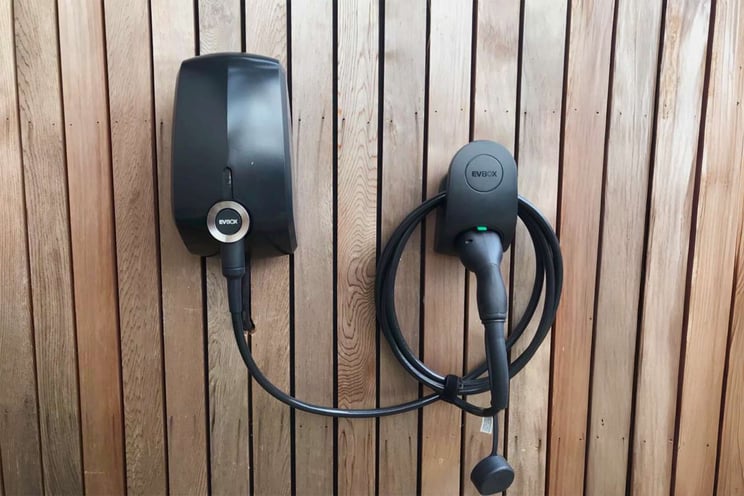
The right EV charger for a solar household depends less on brand loyalty and more on three things: which battery system you already have (or are getting), whether your home has a single or three-phase supply, and how much you care about design. Spirit Energy has installed solar and EV charging systems across more than 6,000 UK homes, and the question of which charger to pair with panels comes up in almost every conversation once a customer has an EV or is planning one.
This guide covers six chargers: the Tesla Wall Connector, Zappi, Hypervolt Home 3 Pro, Andersen A2, and the Sigenergy AC and DC chargers. All prices and features reflect what is currently available in the UK market (accurate as of June 2026).
Does your battery system make the decision for you?
In many cases, yes.
If you have a Tesla Powerwall, the Tesla Wall Connector is the natural pairing. It integrates directly with the Powerwall through the Tesla app, giving you solar generation, battery state, home consumption, and car charging all visible in one place. The Wall Connector does not manage solar diversion independently the way some standalone chargers do: it relies on the Powerwall to handle energy flow. But because the system as a whole is managing that intelligence, the charger does not need to. At around £425*, it is also the most affordable option in this comparison, and it comes with a 7.3-metre cable and a four-year warranty.
The same logic applies to Sigenergy. If you have a SigenStore battery, Sigenergy's 7 kW AC charger integrates directly with it, giving you solar charging modes and full system visibility through the same app. Sigenergy also makes a DC charger (available in 12 kW and 25 kW versions, starting from around £6,300) that is bidirectional, meaning your car can in principle send electricity back into your home or the grid. That is one of the very few genuinely vehicle-to-grid-ready residential chargers currently available in the UK, though it requires the SigenStore battery and the vehicle and software compatibility conditions still apply. For most Sigenergy customers, the charger choice follows naturally from the battery choice.
If you are a Powerwall or Sigenergy household, this decision is largely already made.
What if you are not locked into one of those ecosystems?
Then the choice opens up to three well-established chargers: the Zappi, the Hypervolt Home 3 Pro, and the Andersen A2.
All three are 7 kW chargers on a standard single-phase UK supply. They will all fill a typical EV overnight. They all have app control, all support smart tariffs to some degree, all work with any Type 2 EV (which covers every electric car currently sold in the UK), and all can divert surplus solar generation into your car via a CT clamp. When your panels are generating more than the house needs, these chargers take that surplus instead of exporting it to the grid.
So on the surface, any of these three would serve a solar household well. The differences come down to specific needs.
The best charger for a home with a three-phase supply
If your home has a three-phase supply, the Hypervolt Home 3 Pro drops out of consideration immediately. It is single-phase only, delivering 7.4 kW, and that is its ceiling.
The Zappi and the Andersen A2 both offer three-phase versions capable of charging at up to 22 kW. Worth noting: your car also needs to accept 22 kW, and many do not, so check the vehicle's onboard charger specification before paying the premium for a three-phase unit.
For the vast majority of UK homes on a standard single-phase supply, all three chargers deliver the same 7 to 7.4 kW charge rate.
Tethered or untethered: which suits your household?
A tethered charger has the cable permanently attached, which is more convenient for a single household plugging in the same car every day. An untethered charger has a socket and you bring your own cable, which suits shared or commercial settings, or any situation where different vehicles need to charge.
Both the Zappi and the Hypervolt are available in tethered or untethered versions. The Andersen A2 is tethered only, but uses a hidden cable system where the cable wraps inside the unit when not in use. It looks untethered from a distance and is very well finished. If a genuinely socket-only installation matters to you, the Andersen is not the right fit.
Smart tariff compatibility: does it matter?
Yes, significantly, especially if you have an EV and are not yet on a dedicated EV tariff.
Intelligent Octopus Go is the most widely used EV tariff in the UK right now, charging at around 7p per kWh overnight. All three chargers are compatible with it. The Zappi has been integrated with it the longest and is generally considered the most tried and tested combination. The Hypervolt and Andersen A2 both support it too, with the Andersen integration having been added in late 2025.
One development worth watching: Tesla was granted an Ofgem electricity retail licence in March 2026. There is no confirmed launch date or rate card yet, but if you are a Powerwall owner or drive a Tesla, there may be favourable tariff rates and tighter integration available in due course. It is not a reason to choose a charger today, but worth knowing about.
Does design matter for an EV charger?
More than most people expect, because the charger goes on the front of your house or garage and you will see it every day.
The Zappi is available in black and grey or white and grey. The Hypervolt comes in white, grey, or black. Both look clean and modern for what they are. The Andersen A2 is in a different category: 13 standard metal colours, premium wood fronts, and a range of special edition finishes. If you have spent money on the exterior of your home, the Andersen is worth considering on aesthetics alone. It also carries the longest warranty of any charger in this comparison at seven years.
What about vehicle-to-grid? Is it worth thinking about now?
For most UK homeowners, not yet.
The Zappi, Hypervolt, and Andersen A2 are all one-way AC chargers. Tesla is developing bidirectional capability across its vehicle and energy system, but it is not a mainstream feature for UK Tesla owners at the moment. MyEnergi has announced a dedicated V2G product that will sit above the Zappi in its range, but it has not launched.
The practical exception is Sigenergy's DC charger, which is designed for bidirectional operation and is one of the few residential V2G-ready systems available in the UK today. But vehicle compatibility, software support, and local grid regulations still apply, and it is best thought of as an early-adopter product rather than a mainstream recommendation.
Summary: which charger for which household?
- Powerwall household: Tesla Wall Connector
- Sigenergy household: Sigenergy AC or DC charger
- Three-phase supply needed: Zappi or Andersen A2 (Hypervolt is single-phase only)
- Design is a priority: Andersen A2
- Strongest solar diversion track record and most flexibility: Zappi
- Solid all-rounder without a standout weakness: Hypervolt Home 3 Pro
If you are putting together a solar and battery system and want advice on which EV charger fits your setup, Spirit Energy's design team can talk through the options as part of your system design.
*All prices in this article do not include the install cost.

FAQ
Which EV charger is best for a home with solar panels?
The answer depends on your battery system. If you have a Tesla Powerwall, the Tesla Wall Connector is the natural choice. If you have a Sigenergy battery, pair it with a Sigenergy charger. For everyone else, the Zappi is the most established solar-diverting charger in the UK, with the Andersen A2 the better option if design matters.
Can any EV charger divert surplus solar into my car?
Not all of them. Chargers like the Zappi, Hypervolt Home 3 Pro, and Andersen A2 use a CT clamp to monitor what your panels are generating and divert any surplus into your car instead of exporting it to the grid. Tesla and Sigenergy ecosystem chargers handle this through the battery system rather than the charger itself.
Does it make financial sense to combine solar panels with an EV charger?
For most UK households it does, provided you are also on a smart EV tariff such as Intelligent Octopus Go. Solar covers daytime charging and the tariff covers overnight top-ups at around 7p per kWh. The combination typically reduces the cost of running an EV to well under 2p per mile for electricity, depending on your driving pattern and system size.
What is the cheapest EV charger to pair with solar?
The Tesla Wall Connector at around £425 is the most affordable in this comparison, but it only makes sense if you have a Tesla Powerwall. For households without a Tesla battery, the Zappi is the most cost-effective solar-compatible charger with an independent solar diversion capability.
Who installs EV chargers alongside solar panels in the south of England?
Spirit Energy installs solar, battery, and EV charging systems across southern England and has done so for over 16 years. All system components are designed and installed by Spirit Energy's teams, so the charger, panels, and battery are configured to work together from day one rather than bolted together after the fact.
Is vehicle-to-grid charging available for UK homeowners?
Not in any practical mainstream sense yet. The Sigenergy DC charger is one of the few residential V2G-ready systems currently available in the UK, but it requires the SigenStore battery and vehicle compatibility. The Zappi, Hypervolt, and Andersen A2 are all one-way chargers. MyEnergi has announced a V2G product above the Zappi in its range, but it has not launched.
Do I need a three-phase electricity supply for a fast EV charger?
Not for standard home charging. The vast majority of UK homes are single-phase, and a 7 kW charger on a single-phase supply will fill most EVs overnight. Three-phase allows charging at up to 22 kW, but your car also needs to accept that rate, and many do not. The Hypervolt Home 3 Pro is single-phase only. The Zappi and Andersen A2 offer three-phase versions.