


TL;DR:
Yes, you can install solar panels on a flat roof. Modern ballasted mounting systems are non-penetrative, so there is no drilling through your roof membrane. Panels are tilted at around 10 degrees and can face south or be mounted east/west depending on your roof shape. No planning permission is needed for most properties. A south-facing system in southern England generates around 900 kWh per kWp per year. Costs start at roughly £1,200 to £1,800 per kWp for domestic systems.
This guide covers everything: how flat roof solar is installed, how panels are mounted without damaging your roof, how to work out how many panels will fit, what the planning rules actually say, and what kind of generation and costs you can expect.
How Are Solar Panels Mounted on a Flat Roof?
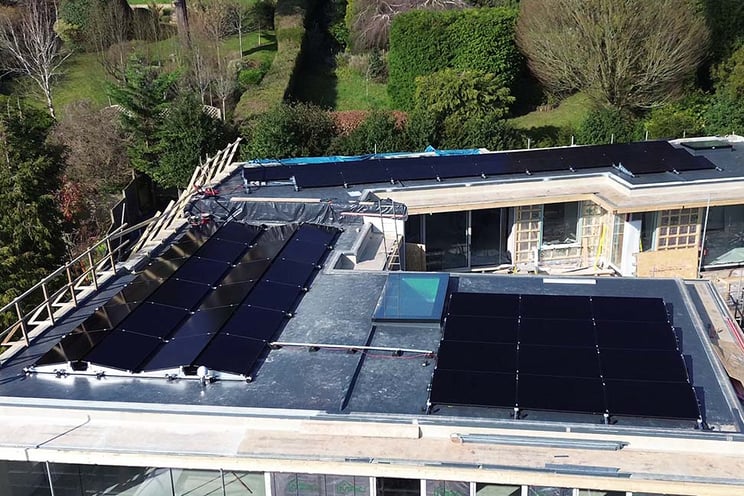
Solar panels on a flat roof are not fixed directly to the surface. They sit on a ballasted mounting system, which means metal frames are placed on rubber feet that spread the weight across the roof, and concrete ballast blocks hold everything in place against wind uplift. No holes are drilled through the waterproof membrane.
At Spirit Energy, we use the Van der Valk ballasted mounting system. We have used it for over a decade. There are cheaper systems on the market, including ones that use plastic tubs, but for something that needs to perform reliably for 30 years or more on your roof, the quality difference matters.
The panels are typically tilted at 10 to 15 degrees. That tilt angle is a deliberate balance: it gives strong annual generation, keeps ballast requirements manageable, and limits the shadow each row casts on the one behind it.
Will Installing Solar Panels Damage My Flat Roof?
No. A properly designed ballasted system leaves the roof membrane completely intact. There are no penetrations, no drill holes, and no risk of leaks introduced by the installation itself.
The frames sit on rubber feet, which spread the load. The ballast blocks, usually pre-cast concrete, are positioned according to a calculated plan, not placed randomly. The heaviest ballast typically goes at the edges and corners, where wind uplift is greatest.
The only structural consideration is weight. A ballasted flat-roof system adds tens of kilograms per square metre, and the exact figure depends on the building height, local wind zone, and array layout. This is why every flat-roof project Spirit Energy undertakes includes a full technical and structural survey before installation begins. A structural engineer confirms how much load the roof can safely carry, including snow loading. This is non-negotiable.
Do You Need Planning Permission for Solar Panels on a Flat Roof?
For most properties in the UK, no planning permission is required. Flat roof solar panels now fall under permitted development, provided the installation stays within a few key rules.
The main one is height: the panels, including their frames and ballast, must not project more than 600mm above the highest point of the roof. Because systems are typically tilted at only 10 degrees, this limit is almost never an issue.
There are exceptions. Listed buildings require consent. Properties in conservation areas or national parks may need to notify the local authority. And panels cannot extend beyond the edge of the roof. But for the vast majority of homes and commercial buildings, the process is straightforward and no formal application is needed.
Should Flat Roof Solar Panels Face South or East/West?
This is one of the most important design decisions for a flat roof system, and the answer is not always obvious.
A south-facing layout at 10 degrees in southern England produces around 91% of the theoretical maximum generation for that location, roughly 900 kWh per kWp per year. An east/west layout produces around 820 kWh per kWp per year per panel.
On paper, south-facing wins. In practice, the decision often comes down to how many panels you can fit.
South-facing rows need around 480mm of clear gap between the back edge of one panel and the front edge of the next to avoid shading. East/west panels face away from each other, so they cast no mutual shade and can be placed almost directly back to back. On many roofs this means you can fit significantly more panels with an east/west layout, which more than compensates for the slightly lower output per panel.
On a recent project in Fleet, we installed 58 panels using a combination of both systems: 24 panels east/west and 34 panels south-facing. That mix was what allowed us to extract the most power from the available roof space.
The right answer depends on your specific roof. At Spirit Energy, we model both options using specialist design software before recommending one.
Are Bifacial Solar Panels Worth It on a Flat Roof?
On a pitched roof, bifacial panels offer minimal benefit because very little light reaches the underside of the panel. On a flat roof, the situation is different.
Light reflects off the roof surface and onto the backs of the panels. If you have multiple rows, light also reflects off the face of one panel onto the back of the one behind it. For south-facing rows in particular, bifacial panels are worth serious consideration. They are not the right choice for every installation, but on the right roof they do offer a measurable improvement.
How Much Does a Flat Roof Solar Installation Cost?
Flat roof systems cost slightly more than pitched roof installations. The mounting hardware is heavier, ballast adds material cost, and a structural survey is required on every project.
At domestic scale (4 to 8 kWp), you are typically looking at £1,200 to £1,800 per kWp, including scaffolding and structural survey. For larger systems above 25 kWp, costs fall to around £800 to £1,200 per kWp. At commercial scale, the economics improve significantly: a 200 kWp system typically comes in around £600 per kWp.
The most important point about system size is this: most of the cost in a solar installation is labour and scaffolding, not panels. If your roof can accommodate 20 panels, installing 10 to save upfront cost rarely makes financial sense. The marginal cost of adding more panels once the scaffolding is up is low, and every additional panel improves your return.
How Much Energy Does a Flat Roof Solar System Generate?
A south-facing system at 10 degrees in southern England, with no shading, generates approximately 900 kWh per kWp per year. An east/west layout generates around 820 kWh per kWp per year, though the ability to fit more panels on the same roof often brings total annual generation above the south-facing equivalent.
If you would like to see what your flat roof could save you on your energy bills contact Spirit Energy for a free, bespoke quotation.

Frequently Asked Questions
Can solar panels be installed on any flat roof? Most flat roofs are suitable, but a structural survey is essential before installation. The survey confirms the roof can carry the added weight of the panels, mounting frames, and ballast safely.
Do flat roof solar panels leak? A ballasted non-penetrative system does not require any holes in the roof membrane. When installed correctly, there are no new leak points introduced.
What is the best tilt angle for flat roof solar panels? 10 to 15 degrees is the most common range. It balances generation output, ballast requirements, and row spacing efficiency.
How long do flat roof solar systems last? The panels themselves typically carry a 25 to 30 year performance warranty. A high-quality mounting system such as Van der Valk is designed to last the same period.
Can I install a battery alongside a flat roof solar system? Yes. A battery such as a Tesla Powerwall stores surplus generation for use in the evening or overnight, improving self-consumption and reducing grid reliance.