


Why electricity bills keep rising in the UK
Electricity bills in the UK continue to rise because the market is still heavily influenced by global energy prices, particularly gas. Even though we generate a growing share of electricity from renewables, gas often sets the wholesale price of electricity. When global supply is disrupted or demand increases, prices rise across the board. This has been seen repeatedly in recent years, and it means households remain exposed to factors completely outside their control. As long as the UK relies on gas as a core part of its energy mix, price volatility is likely to remain.
How solar panels actually reduce your electricity bill
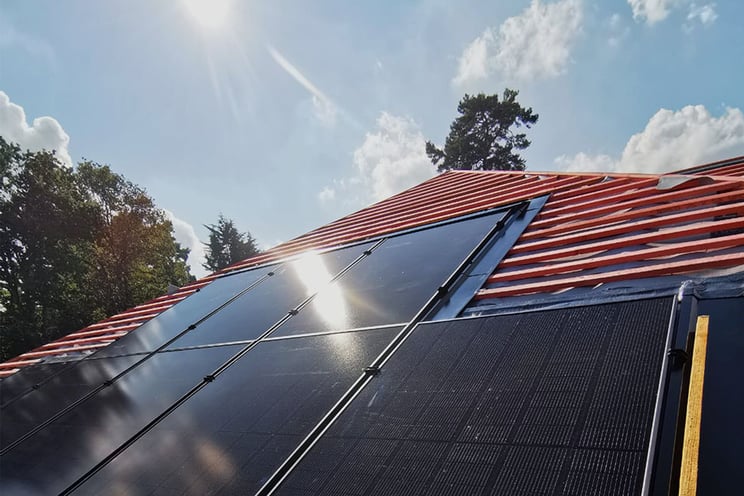
Solar panels reduce your electricity bill by allowing you to generate and use your own power instead of buying it from the grid. During daylight hours, your system produces electricity that your home can use instantly, which directly offsets what you would otherwise pay your supplier. The more of this energy you use yourself, the greater your savings. Rather than being fully dependent on fluctuating tariffs, you are effectively fixing a portion of your energy costs by producing it on your own roof.
What about selling electricity back to the grid?
If your solar system generates more electricity than you can use, the excess can be exported back to the grid through schemes like the Smart Export Guarantee. This allows you to earn money for surplus energy, creating an additional return on your system. However, export payments are typically lower than the cost of buying electricity, so the real financial benefit comes from using your own energy first. Exporting should be seen as a bonus rather than the primary driver of savings.
Why batteries make such a big difference
A battery significantly increases the value of a solar system by allowing you to store unused electricity and use it later. Without a battery, excess energy generated during the day is often exported, and then electricity is bought back from the grid in the evening when demand is higher. With a battery, that daytime energy can be stored and used when it is needed most, reducing grid reliance further. This improves overall efficiency and helps smooth out usage patterns, which is increasingly important as the UK energy system evolves towards more decentralised storage solutions.
Are solar panel prices going up?
Solar panel prices themselves have generally trended down over time due to improvements in manufacturing and global supply. However, recent developments in China and the middle East will cause the solar panel prices to go up. Overall system costs can still fluctuate depending on demand, labour, and supply chain pressures. In periods where energy prices spike, demand for solar often increases, which can push installation costs higher. More importantly, delaying a solar installation means continuing to pay rising electricity bills, which often outweighs any small future reduction in system prices.
Is there another energy crisis coming?
While it is impossible to predict exactly when prices will spike again, the underlying conditions that caused recent energy crises have not fully gone away. The UK is still reliant on imported fuels, and global events can quickly disrupt supply chains. At the same time, electricity demand is increasing as more homes adopt electric vehicles and heat pumps. This combination creates ongoing uncertainty, meaning price volatility is likely to remain a long-term feature of the energy market rather than a one-off event.
Final thoughts: is solar worth it?
Solar is worth it because it reduces your reliance on an unpredictable energy market, lowers your electricity bills, and gives you long-term control over your energy costs. Request a quote with us today to learn more about your roof's capabilities.