

TLDR:
Solar panels work throughout winter in the UK. Output is lower because sunlight levels drop, but panels continue generating on cloudy, rainy and cold days. Cold weather actually often improves efficiency. Hail damage is rare because panels undergo strict impact testing.
Do solar panels work in winter?
Summary: Solar panels continue generating through winter because they rely on light, not heat. Your system will produce less electricity, but it does not switch off.
Solar PV cells generate electricity when daylight hits the semiconductor material. Winter brings shorter days and lower sun angles, which reduces production, but there is still more than enough available light for generation. A typical UK system produces around 10% of its annual yield between December and February (depending on the location).
Key factors reducing winter yield:
• Shorter daylight hours
• Lower solar irradiance
• Frequent cloud cover
• Increased shading from low sun angles
Even on a dull day, diffuse light still produces power. Output varies, but generation does not stop.
Check out our video and our blog about Sam's system one year on where we compare our predicted outputs with the system's actual outputs throughout all the seasons:
Do solar panels work better in cold weather?
Summary: Yes. Cold temperatures can improve the electrical efficiency of solar panels.
Solar panels operate more efficiently at lower temperatures. When panel temperature rises above 25°C, voltage drops slightly, reducing output. In winter, natural cooling keeps the panels close to their ideal operating temperature. As a result, a clear, cold winter day can deliver higher efficiency than a very hot summer day.
Cold weather does not increase total winter generation, because the limiting factor is sunlight, not temperature. However, it does ensure your panels work as efficiently as possible with the available light.
How much energy do solar panels generate in winter?
Summary: Winter generation is lower, but predictable and factored into all annual yield estimates.
Typical features affecting winter output:
• Roof orientation
• Pitch angle
• Shading
• Panel efficiency
• Local climate
• Inverter design and optimisation
South-facing roofs with a pitch of 30 to 40 degrees give the strongest winter performance. East and west roofs continue generating but at reduced levels. A battery can significantly increase winter self-consumption by storing the limited daytime generation for evening use.
All industry-standard performance models include winter variability, so your quoted annual output already accounts for seasonal drops.
Do solar panels work when it snows?
Summary: Light snow has limited effect. Heavy snowfall temporarily blocks generation until it slides or melts.
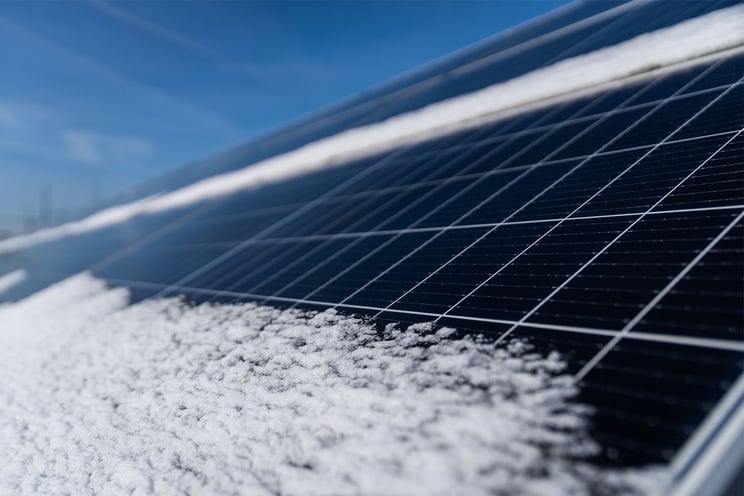
Panels are made from smooth, anti-reflective glass. Light is usually able to penetrate through 5 to 8-centimetre layers. Additionally, snow tends to melt rapidly once the panel absorbs light or heat from the building. Snow does not usually need manual clearing on pitched roofs. Once the glass surface warms slightly, snow sheets off on its own.
In some situations, cold and snowy conditions can slightly increase solar output through the albedo effect. When snow is present on the ground but not covering the panels, it can reflect additional sunlight onto the solar cells, marginally increasing the amount of light the system receives.
Can frost damage the solar panels? Not really. Freezing is generally harmless, unless the panel is damaged and water manages to enter the cracks. If you are concerned about snow or frost, you can always enquire about a professional cleaning service for your solar system.
If snow does accumulate heavily, generation pauses until the panel surface clears.
Hail damage on solar panels
Summary: Hail damage is rare. Panels are tested to withstand large hailstones travelling at high speed.
Opt for panels rated UL 61730, UIC 61730, or IP68 as they can withstand far more pressure from such extreme weather events. High-quality panels can withstand significantly more than typical UK hail conditions.
If hail damage does occur, it is usually visible as fractured glass. Damaged modules must be replaced, as cracks reduce performance and allow moisture ingress. To prevent this you can also consider adding a protective cover or wire mesh as they can protect the panels while still allowing for sunlight absorption. Opt for such protective measures if necessary.
In the UK, hail strong enough to damage solar modules is uncommon. Product and performance warranties protect you in the event of a manufacturing fault.
Many homeowners also ask whether solar panels work in cloudy weather. While thick, low cloud can reduce output to around 10 to 20 percent of normal capacity, higher cloud can sometimes increase sunlight briefly through a phenomenon known as cloud lensing, and you can read more about this in our dedicated blog on clouds and solar performance.
Key winter performance considerations
• Solar panels work throughout winter
• Cold weather can improve panel efficiency
• Reduced sunlight is the main constraint, not temperature
• Snow rarely causes long-term issues
• Hail damage is uncommon due to strict impact testing
• A battery improves winter utilisation
• Clouds do not have a significant impact on the system
But first, if you’re interested in getting your own solar panels, the most important thing is to find a trusted installer.
Contact our expert team if you would like to receive a bespoke solution for your home or business.

FAQs
Do solar panels stop working in winter?
No. They continue generating whenever there is daylight.
Do solar panels need direct sunlight to work?
No. Panels generate electricity from diffuse light as well as direct sunlight.
How much does cold weather improve efficiency?
Cold conditions keep panel temperature closer to the ideal 25°C test point, improving voltage and overall efficiency.
Can hail break solar panels?
It is possible but rare. Panels are tested to withstand large hailstones and are designed for harsh outdoor conditions.
Will snow or frost damage solar panels?
No. Snow and frost do not harm modules. It only blocks light temporarily.
Is winter generation included in annual yield estimates?
Yes. Winter reduction is fully accounted for in all annual performance figures.