

A solar installer was fined £120,000 in December 2024 after a worker slid off a roof adjusting panels and broke his femur - the company had provided no edge protection. The job involved moving nine panels. The HSE found the work at height had not been properly planned. This is not an isolated case, and it tells you something important about how to evaluate any solar quote you receive.
What UK law actually requires for rooftop solar installation
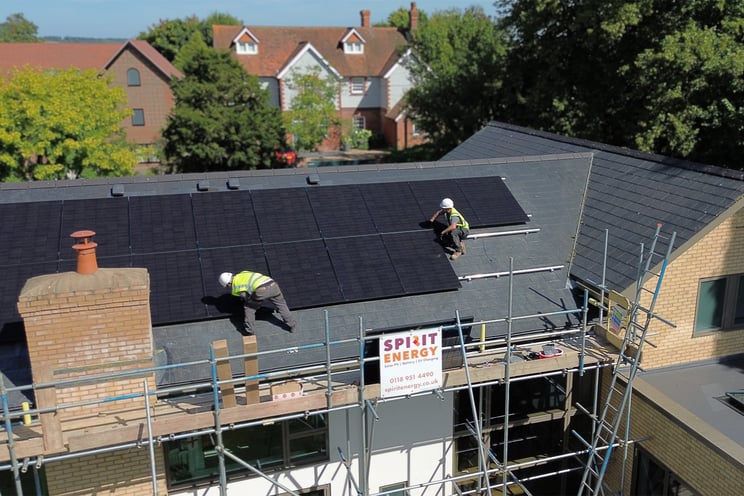
The Work at Height Regulations 2005 require all work at height to be properly planned, supervised, and carried out by competent people. For solar panel installation, the HSE is explicit: this is not short-duration work, and a boarded working platform with full edge protection is required. That means double guardrails, toe boards, and where necessary, debris netting.
Ladders are not a compliant access solution for a rooftop solar installation. A scaffold tower may be acceptable in a narrow set of low-risk scenarios, but it must still meet the same planning and risk assessment requirements.
Failure to comply carries real consequences: fines of tens of thousands of pounds, voided insurance policies, and in some cases, prosecution under the Health and Safety at Work Act 1974.
What scaffolding actually does on an installation
The obvious function is fall prevention. But scaffolding also changes the quality of the work.
On a properly erected scaffold, an installer can move panels, tools, and cabling without overreaching or rushing. That matters for cable management, fixing torque, roof penetration quality, and the general care taken across the job. Rushed or awkward working conditions produce poor workmanship - and poor workmanship on a solar installation means leaks, system faults, or fire risk from cables that have not been properly secured.
Spirit Energy engineers understand this: even though, for example, flat roof work may look safer than pitched roofs, it still requires scaffolding with edge protection and proper fall prevention measures. At Spirit Energy, all of our 6,000+ installations across England have used in-house teams working under full health and safety procedures. That is non-negotiable, regardless of how it affects job cost or duration.
The question worth asking before you sign anything
If a company quotes for your solar installation and the quote does not include scaffolding, ask why. Some installers will tell you they use harnesses, rope access, or that your roof is low enough to manage differently. That may occasionally be true. But in the majority of domestic pitched roof installations, full scaffold with edge protection is the correct and legally required solution.
There are installers who will arrive with a ladder on the day and get it done. That approach may be cheaper. But it is worth asking whether a company that is willing to put its own workers at risk is the kind of company that will be around in ten years to honour your warranty and support your installation.
A solar PV system should generate returns for 25 years. The company that installs it needs to still be operating and standing behind its work. Cutting health and safety is often a sign of wider cost-cutting - on components, design quality, or aftercare.
Commercial installation scaffolding
For commercial customers, the risks are compounded. A larger installation means more workers on the roof, more time at height, and more opportunity for something to go wrong. Flat roofs, which are common on commercial buildings across the UK, can create a false sense of security - they feel safer than pitched roofs, but without edge protection a worker can step off the edge without warning. If an incident occurs on your premises, you as the building owner or occupier may carry liability under the Health and Safety at Work Act 1974 alongside the installer. Before any commercial installation begins, ask your installer for their method statement, risk assessment, and evidence that scaffolding or edge protection is included in the scope of work.
Does scaffolding add to the cost?
Yes, scaffolding is a cost. A typical domestic installation in southern England includes a scaffolding estimate. At Spirit Energy, we include that as standard, alongside a structural survey for all installations.
The scaffolding cost is proportionally small relative to the overall system investment and the 25-year operational value of a correctly installed system. For us - it is not optional.

FAQ
Is scaffolding a legal requirement for solar panel installation in the UK?
Yes, for almost all rooftop installations. The Work at Height Regulations 2005 require that solar panel installation - which is not classified as short-duration work by the HSE - must use a boarded working platform with full edge protection, including double guardrails and toe boards. Ladders alone do not meet this requirement.
Can a solar installer legally use a harness instead of scaffolding?
In limited circumstances, yes. Rope access or harness systems can be used for specific, low-risk scenarios, but they must still meet the planning, supervision, and risk assessment requirements of the Work at Height Regulations 2005. They are rarely appropriate as the primary access solution for a full domestic roof installation. If an installer is proposing harnesses rather than scaffold as a cost-saving measure, ask to see their written risk assessment and method statement before agreeing to proceed.
What should I check before hiring a solar installer regarding safety?
Confirm the quote includes scaffolding or states clearly what access method will be used and why it is compliant. Ask to see evidence of MCS certification, public liability and employer's liability insurance, and a method statement for working at height. Be cautious of any installer who treats the scaffolding question as a minor detail or who offers to omit it to reduce the price. A legitimate MCS-certified installer operating under proper health and safety procedures will have straightforward answers to all of these questions.