


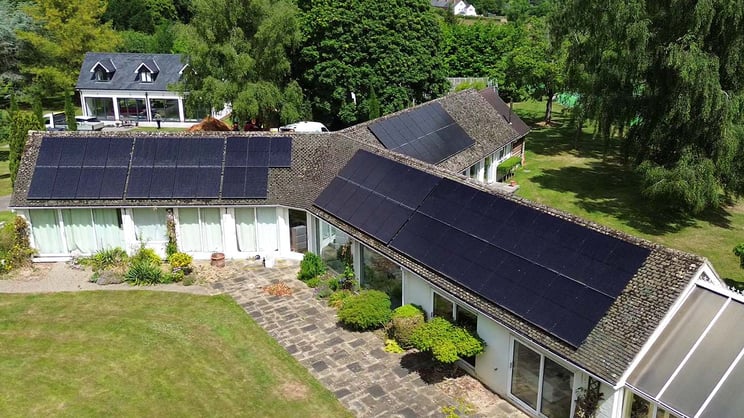
The fastest way to improve your solar panel payback period is to maximise generation per square metre of roof, because the panels themselves are only about 5 to 10% of total system cost. The labour, scaffolding, and inverter stay roughly the same whether you fit a modest array or fill the roof, so the real question is not how cheap the panels are but how much electricity each metre of roof can produce. Get the design, the installer, and the post-install setup right and a well-configured system can repay itself in six to seven years in southern England.
These 12 factors fall into three areas: system design, choosing the installer, and how you run the system once it is live. They come directly from the hundreds of systems Spirit Energy designs and installs across the UK each year.
Why maximising roof coverage matters more than panel price
Panels are the part of the system that actually earns money, yet they are the cheapest component. On a panels-only install they are around 20% of cost; paired with a battery they drop to about 10%. Everything else is fixed.
That changes the logic. Covering the largest possible area with cells, rather than buying the cheapest panels, is what drives return. Even a 5 to 10% increase in system size compounds into significant savings over 25 years and will outweigh the small extra upfront cost.
Maximising coverage does not always mean more panels. A smaller number of larger panels can deliver a higher kilowatt peak from the same roof. Spirit Energy typically models three panel sizes per roof: standard around 500W, larger around 540W, and jumbo around 660W. Jumbo panels are often cheaper per watt and need less mounting kit, so in many cases they cut system cost while increasing generation.
Should you DC couple or AC couple your solar battery?
DC couple it. DC coupling means the panels connect directly into a hybrid inverter built into the battery, so electricity is inverted once before it is used. With AC coupling, surplus electricity is inverted to enter the house, inverted again to charge the battery, then inverted a third time to discharge. Each conversion loses energy, and over 25 years those losses add up.
There is also a scaling problem specific to the UK. AC coupling uses a separate inverter for solar and another for the battery, and your DNO limits total inverter capacity. Most homeowners would struggle to get above about 12kW combined. If you want a serious solar array and a meaningful battery, that ceiling becomes a real constraint fast.
DC coupling shares a single hybrid inverter between solar and battery, so the system scales far more freely. If you expect your energy needs to grow, AC coupling can lock you out of expansion.
Does a bigger battery improve solar panel ROI?
No, and this surprises people. If you are optimising for payback, do not oversize the battery, and if anything slightly undersize it. A battery earns its keep by fully cycling cheap electricity, ideally at least once every day, and discharging all of it into the house rather than back to the grid.
Oversize beyond what your home can consume during the peak-rate window and part of the capacity sits idle. That idle capacity does not just do nothing, it drags down the return on the capacity that is paying for itself.
Choose a modular system instead. The Tesla Powerwall 3 and Sigenergy Sigenstor both allow you to add DC storage later without replacing existing hardware. Install a sensible size now, gather a year of real-world data, then add storage only if your consumption genuinely warrants it.
Do microinverters, optimisers, and hot water diverters improve payback?
Usually not, and your installer should be asking whether they improve your payback before recommending them. Optimisers and microinverters exist mainly to mitigate shade. On a roof shaded by a chimney, trees, or a neighbouring property they can help, but on a clean roof you may pay a premium to solve a problem you do not have.
There is also warranty risk. These units carry 25-year warranties, but those typically cover only the unit cost plus a small labour contribution. Replacing a faulty unit on a roof can run into hundreds of pounds before scaffolding, which can wipe out any generation benefit. Newer panels from manufacturers like Aiko and Longi now build shade mitigation into the panel itself, avoiding roof-level electronics entirely.
Hot water diverters rarely stack up either. Gas currently costs around 6 to 7p per unit. If your export rate is higher than that, which it usually is in 2026, you are better off exporting the surplus and paying for gas. A diverter only makes sense if your export rate falls below your gas rate or you cannot export at all, and a well-sized battery absorbs most surplus anyway.
Are wall-mounted or in-roof solar panels worth considering?
Both are worth knowing about. Wall-mounted panels are more viable than most assume. Scaffolding is often simpler than a roof install, which keeps costs down, and they generate only about 29 to 38% less than an equivalent roof array. In winter they can outperform roof panels, because the lower sun hits a vertical surface at a better angle, exactly when you need generation most. An east or west wall array peaks morning or evening, complementing a south-facing roof.
In-roof systems make sense if you are re-roofing soon. Tying solar in with roof works shares the scaffolding cost across both projects. In-roof panels sit in trays that replace tiles, so the finish is flush and you save on tile costs. The trade-off is reduced layout flexibility, so ask your installer to run the numbers on in-roof versus on-roof.
How does choosing the right installer affect payback?
Significantly, and it is underrated. You want an installer with the flexibility to use different panel types, sizes, and layouts to find the highest kilowatt peak for your roof, sometimes using one panel type on one roof and another elsewhere. National installers often buy one panel type in bulk and fit it everywhere regardless of fit.
The gap is real. At the time the source video was made, one large national installer offered a 455W panel as standard while local specialists like Spirit Energy fitted 490W panels of almost identical physical size. That is nearly 10% more generation from the same roof area over 25 years, and it boosts winter generation when you need it most.
Before committing, check reviews, check the installer's financial position on Companies House, confirm whether they use in-house teams or subcontract, and ask how long they have been trading. Aim for at least five years' track record. Some installers have faked accreditations, leaving homeowners unable to certify their systems, so verify the credentials claimed on their website.
Why the DNO application protects your payback
Before installing a system above a certain size, your installer must apply to your local Distribution Network Operator for permission to connect. Some installers cap the inverter at 3.68kW to skip this application, because it speeds up the install and reduces their admin.
Do not let them. The system should be designed for the next 25 years, not the installer's convenience. We get calls from people sold a 6kW system that turned out to have a 3.68kW inverter, physically capped well below what they paid for. If the grid can take a larger system, use that capacity. If it cannot today, choose hardware that can be software-upgraded later.
A bad install is expensive to fix. The remediation cost usually exceeds whatever was saved on the cheaper original quote, so paying for quality on your roof is worth it.
Self-sufficiency or time-of-use: which pays back faster?
Time-of-use, in most cases. The instinct is to maximise self-sufficiency by using as much of your own solar as possible. But maximising self-sufficiency is not the same as maximising savings. Most modern batteries have a time-of-use mode that charges overnight at around 7p per unit on the right tariff, then uses that cheap electricity during the day while exporting surplus solar at a higher rate.
In Spirit Energy's one-year Tesla Powerwall 3 case study, the system covered only 56% of the home's electricity needs, which sounds unimpressive, yet because it was configured for time-of-use it delivered over £1,800 in total value in year one. The rule of thumb is that 60 to 80% grid independence is the sweet spot for an attractive return. Beyond that you are buying storage to cover deep winter, which sits underused the other nine months and pulls down the return on the rest of the system.
Should you charge an EV from solar or an overnight tariff?
Counterintuitively, overnight is usually better. In most cases you are financially better off exporting your excess solar and charging the car overnight on a cheap off-peak tariff than charging directly from solar during the day. The export rate on most EV-friendly tariffs is higher than the off-peak import rate, so you profit from the difference. Charging from the home battery is worse still, because you add round-trip losses on top. It is a small gain, but it is effectively free after five minutes setting your charger to off-peak hours.
Shifting appliances and protecting winter performance
Two final habits cost almost nothing. On a sunny day, run high-consumption appliances like the washing machine, dishwasher, and tumble dryer during peak generation hours so you use your own solar. In autumn and winter, shift them to your off-peak window and use cheap overnight electricity. It is a few minutes on the timer settings.
Finally, check the battery's thermal management. Winter is when the battery should save you the most, with prices high and solar low, but it is also coldest. A battery that cannot manage its temperature may fail to charge off-peak below about 5°C, and those winter savings vanish. The systems Spirit Energy installs, including Powerwall 3 and Sigenstor, both manage temperature actively. Ask any installer how their proposed battery handles cold weather.