


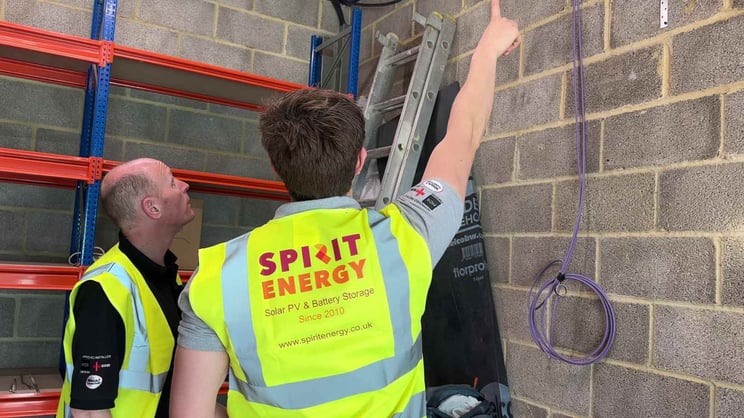
Every one of Spirit Energy's 6,000-plus installations since 2010 has had a technical and structural survey carried out by one of its head electricians before any panel goes up. The survey is where a £10,000-plus, 25-year investment is either set up to succeed or quietly compromised. This is what a proper one actually checks, based on a live survey at a new build home in Reading, southern England, audited on the day by no other than GaryDoesSolar.
What does a solar panel survey actually check?
A proper survey looks at five things: the roof, the loft, the cable routes, the kit locations, and the structure underneath it all. The surveyor measures the roof rather than eyeballing it, checking the tiles for damage (some visible, some not) and confirming that the system that was sold will physically fit the available space.
Almost every homeowner asks the same question at the end: can I get more panels on? A good surveyor checks for that too, not as a sales tactic but because the expensive part of solar is the labour and scaffolding, not the panels themselves. Once the access is paid for, squeezing the most generation out of the roof is what produces the best long-term return.
Can solar panels go close to the edge of the roof?
Yes, and this is one of the most common things technically minded clients query. The MCS guidance under MIS 3002 suggests staying around 400mm back from the edge of the roof. Plenty of homeowners read that as a hard limit and assume a panel near the edge means a corner-cutting installer.
It is not a hard limit. You can install closer to the edge provided you run a full structural survey and properly design the mounting brackets and roof layout so the array is fixed securely. Spirit Energy does both as standard. Done correctly, encroaching on that guideline boundary is not a problem, and it is sometimes the only way to fit the array a homeowner actually wants around obstacles like roof windows.
How do the mounting brackets fix to the roof?
There used to be a belief that the roof hooks attach to the battens, the thin horizontal timbers the tiles sit on. They do not. The hooks fix to the rafters, the main structural timbers, between the battens, and are screwed in with two screws each.
On the Reading project the rafters were 125mm. The screws do not poke through to the inside of the roof, and a survey measures the rafter spacing and size precisely so the mounting design matches the actual structure rather than an assumption.
Why are the AC and DC cables kept separate?
DC cabling carries a particular risk if it is run just behind the surface of the plasterboard: it needs mechanical protection in that situation. A survey plans cable routes so DC runs are sunk well back, behind ducting and pipework, and kept separate from the AC.
On a retrofit, which is what most homes are, the surveyor plans how to hide cabling internally without tearing the house apart. The order of preference is external routing first, then internal routes through existing cupboards or risers, with lifting carpets and floorboards treated as a genuine last resort. The aim is to leave the property looking as though nobody has been there, with no cables on show.
Where do the inverter and battery go?
Kit placement is decided at survey, not improvised on install day. The gateway, the unit that allows power-cut protection, has to sit as close as possible to the incoming supply, because the incoming supply cables (the tails) should not be extended more than about 3 metres. Extending them is possible but means extra switchgear and fuses.
The battery itself is more flexible. A Tesla Powerwall, for example, can sit up to around 45 metres from the gateway, so it can go almost anywhere sensible. On the question of inside or outside, the recommendation is inside, or at least a garage, because of thermal management. Batteries do hum slightly and give off a little heat, so a living space is not ideal, but a garage keeps the cells in a better temperature range. Older Powerwall 2 units throttle their charge rate near freezing, while the Powerwall 3 forecasts temperature swings and pre-heats or pre-cools the cells to hold them in their optimal range.
Does a survey matter as much for commercial solar?
If anything more. A care home, warehouse or office roof carries larger arrays, more complex cable runs, and a bigger capital outlay, so a structural and electrical survey is what protects an installation that needs to run for 25-plus years to deliver its return. Across Spirit Energy's commercial portfolio the difference between a survey that maximises a roof and one that leaves capacity on the table can be thousands of pounds a year in generation, on systems where payback already sits in the 3 to 6 year range. The same principles apply at scale: measure the structure, design the mounting to it, plan the cable routes, and place the plant correctly the first time.
Why survey quality is worth caring about
A solar and battery system is, for most people, one of the three most expensive things they will ever buy. Industry surveys through 2025 flagged a growing split between quality installers and underqualified newcomers entering a booming market, and the survey is the first place that gap shows.
Getting the design right at survey stage is what makes the difference over 25 years. Paying a little more for an extra 5% of generation off the roof is straightforward maths when it compounds across two and a half decades of ownership. The survey is not a formality before the real work. It is the work.