


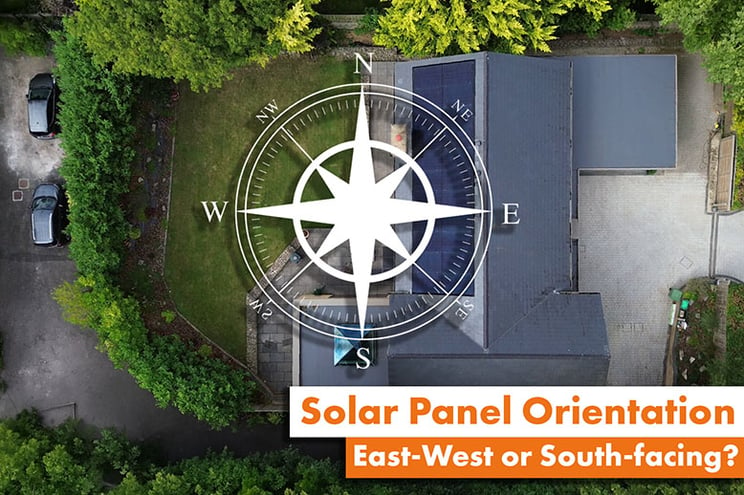
South-facing solar panels produce more electricity per panel than east or west-facing ones, but east-west systems often produce more electricity overall, and the daily generation profile can be a better match for how most households actually use power. Whether south-facing is "better" depends on what kind of roof you have and what you are trying to achieve. For many homes, the most useful answer is that neither orientation is best used exclusively.
What does "south-facing vs east-west" actually mean for your roof?
The answer divides into two distinct scenarios, and most of the confusion online comes from treating them as one question.
If your roof has a ridge running roughly north-south, your slopes face east and west. Since your orientation is already decided by your roof, your only real choice is whether to install panels on just one side or both.
If your roof is flat, you have a genuine choice. Panels can be mounted facing south, or in an east-west formation using opposing frames. That is a design decision that needs to be modelled properly for your specific roof before anyone commits to a layout.
If your pitched roof faces east-west: use both slopes
A ridge running north-south gives you east-facing on one side and west-facing on the other. East panels generate well in the morning; west panels generate from mid-afternoon into the evening. Together they produce a broader, flatter generation curve across the day than a south-facing system of the same installed capacity.
Per panel, east or west-facing arrays produce less than a south-facing roof at a comparable pitch. But the more important point is that an east-west home can typically carry panels on both sides. A larger east-west system using both slopes usually produces more total electricity per year than a smaller south-facing system using one.
There is a secondary benefit worth noting if your household is out during the day. A south-facing system peaks hard around midday, when most working households have low demand. That surplus is exported to the grid at Smart Export Guarantee rates, which are modest. An east-west split captures more generation during the morning and late afternoon, which is closer to when most households need electricity. That alignment with real usage patterns tends to increase self-consumption without needing a battery to bridge the gap.
If your roof is flat: the layout is a design decision
On a flat roof, the orientation of every panel is chosen by the installer, not dictated by the roof slope. That makes it a proper engineering decision, not a default.
South-facing rows maximise midday output but need spacing between them to prevent each row shading the one behind, particularly in winter when the sun sits lower. East-west pairs face opposite directions and do not shade each other in the same way, so they can be mounted more closely together. On many flat roofs, that denser packing means more panels fit overall, which can offset the slightly lower output per panel.
The right approach depends on the specific roof geometry and how generation needs to be distributed across the day.
Spirit Energy recently installed a 27.84 kWp system on a large flat roof in Surrey, on a new build with 10,000 kWh of annual household demand plus an EV to charge. Read the case study here. Rather than defaulting to a single orientation, the design used 34 panels in a south-facing layout and 24 in an east-west formation, split across four separate arrays. The hybrid arrangement was what extracted the most annual generation from that particular roof. The system is forecast to generate 21,415 kWh per year and cover 83% of the household's electricity demand without drawing from the grid at standard rates.
That kind of outcome is not achievable by pointing everything in one direction and hoping.
How your energy use affects which layout suits you
If your household uses most of its electricity during the day, a home office, someone at home full-time, a household with young children, a south-facing system is well matched. You consume the generation as it happens, which keeps self-consumption high without needing battery storage to make up the difference.
If demand peaks in the morning and evening, an east-west split aligns more naturally with that pattern. You are capturing morning generation during breakfast and the start of the day, and picking up the afternoon and early evening run from the west-facing side.
Battery storage changes the picture. With a properly sized battery, surplus generation from any orientation is captured for evening use, which narrows the self-consumption gap between south-facing and east-west systems. But it does not eliminate the generation profile difference entirely. The Surrey installation uses two Tesla Powerwall 3 units with an expansion pack, giving 40.5 kWh of usable storage. Even at that scale, the hybrid panel layout was still the right design choice for the roof, because orientation and storage are separate decisions that compound rather than cancel each other out.
What a good installer should model for you
Orientation is one variable in a system design. Shading tends to have a larger effect on output than orientation: a chimney, a neighbouring rooftop, or a tree that has grown since the house was built can reduce generation by more than any difference between layout options.
Before settling on a layout, a competent installer runs a simulation using your actual roof dimensions, your postcode, your electricity usage, and a shading analysis. The goal is the best return on investment for your roof, not a generic recommendation applied without thought.
The orientation question is worth understanding. But the right answer for your home comes from a model of your specific situation, not a rule of thumb.