

The add-ons on a UK solar quote fall into three groups. Bird mesh costs about £25 a panel and ArcBox connector enclosures about £25 each, and both are cheapest fitted during the main install, because adding them later usually means paying £600 to £800 for scaffolding again. Hot water diverters and optimisers only pay off in specific homes, and a mains voltage optimiser sold to solar owners is one to refuse.
Why add-on timing matters on a solar quote
Anything fitted at roof level needs access. On a two-storey house with panels on one elevation, putting scaffolding back up typically costs £600 to £800 before any work starts.
VAT is the second reason. Installing qualifying energy-saving materials in a home, including solar panels and batteries, is zero-rated until 31 March 2027, after which the rate is scheduled to return to 5%. Items bought separately that aren’t on HMRC’s energy-saving list, such as bird mesh fitted on its own, are charged at the standard 20%.
Solar panel bird proofing
Panels sit about 160mm above the roof on mounting rails. That gap keeps the panels cool, and a cooler panel generates more. It also gives pigeons a dry, sheltered space to nest.
Once birds move in, nesting material blocks the airflow, droppings wash into gutters, and birds peck at soft materials, including DC cabling.
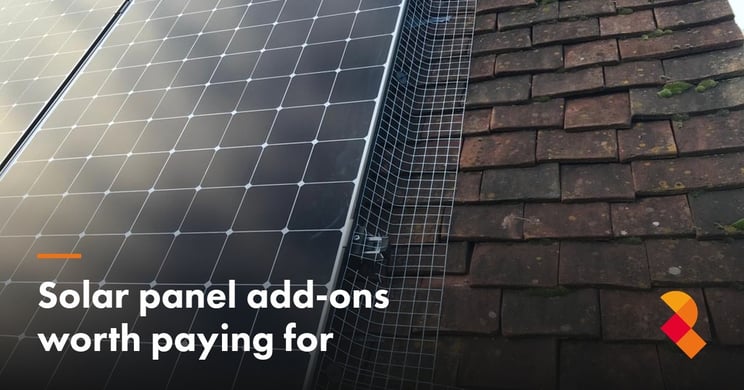
Mesh is the most common fix. It’s PVC-coated stainless steel, usually with a 25mm aperture, clipped to the panel frames around the edge of the array. There’s no drilling into panels or the roof, and airflow isn’t affected. Spirit Energy includes it as standard, but many installers charge for it.
Not every roof needs it. Look at your neighbours’ panels. If they have a bird problem, you probably will too.
SolaSkirt is the main alternative. It’s a moulded trim that closes the gap and looks much neater. It costs more per panel, lets less air through than mesh, and only seals properly on flat tiles. On pantiles or other profiled tiles it leaves gaps, so it becomes more cosmetic than protective.
ArcBox enclosures for DC connectors
Solar panel cables are joined with MC4 connectors. At the end of each string, the installer assembles the final connector by hand on site. A poor crimp, or two different brands of connector mated together, can lead to an electrical arc hot enough to melt metal.
An ArcBox, made by UK manufacturer Viridian Solar, is a hinged enclosure that snaps around the connector. If an arc happens, the enclosure contains it so it can’t reach nearby combustible materials. It doesn’t stop the fault, but it stops a fault becoming a fire.
The recommendation is two per string, one on the positive and one on the negative. Spirit Energy fits them for about £50 a string. They matter most on in-roof systems, where connectors can sit under tiles beside timber battens and membrane.
Properly assembled connectors rarely fail, which is why Spirit Energy uses Stäubli MC4s. The ArcBox covers the case where something wasn’t done properly, and you won’t know which case you’re in until it’s too late.
Is a solar diverter worth it?
A hot water diverter sends surplus solar to your immersion heater instead of exporting it. Whether that saves money depends on how you heat water now and what your export tariff pays.
Under the October 2026 price cap, gas costs 7.97p per kWh. Allowing for boiler and cylinder losses, a unit of hot water from gas costs roughly 9p.
On a 12p export tariff, every unit you divert saves about 9p of gas but loses 12p of export income. Divert 500 units over a summer and you’re around £15 worse off, before paying for the diverter.
On a 4p export rate, or with no export tariff, diverting saves about 5p a unit.
The clear win is a home without gas. If your hot water already comes from an immersion, you’re buying that electricity at 26.32p under the current cap. Diverting saves about 14p a unit after lost export.
Two things reduce the benefit. A well-sized battery absorbs most surplus before the diverter sees it, and if you have a heat pump, an immersion is the least efficient way to heat water.
A diverter fitted later still counts as an energy-saving material for VAT, so there’s no need to rush this one onto the original order.
EV chargers fitted with solar
If you have an electric car, or expect to, fitting the charger alongside your solar is simpler. The cable run, load balancing and earthing are easier while the electrician is already working on your consumer unit, and you pay for one visit.
Ask your installer how the charger will be treated for VAT. It only shares the zero rate if it forms part of the same supply as the solar, which isn’t automatic.
Many battery brands now make their own charger that runs in the same app, so solar charging and scheduling sit in one place. Whether charging your car from solar makes financial sense is a separate question, and the answer surprises most people.
Solar optimisers and micro inverters
Optimisers and micro inverters put electronics behind each panel, so a shaded panel doesn’t drag down the rest of the string. On a roof with a real shading problem, that can help.
They cost considerably more, and they put complex electronics on a roof for 25 winters. Warranties usually cover the part with little towards labour, and a replacement can mean new scaffolding. One failure can wipe out the extra generation they produced.
On an unshaded roof, you’re paying to fix a problem you don’t have. Ask any installer recommending them for two performance models, one with and one without, and compare the difference.
Battery warranties and extensions
Two batteries can both carry a 10-year warranty and promise very different things.
The Tesla Powerwall 3 is covered for 10 years in the UK, with at least 80% capacity retained and unlimited cycles for normal home use (solar self-consumption, time-of-use tariffs and backup). In Spirit Energy’s experience, Tesla has even replaced some Powerwall 2 units with Powerwall 3s under warranty. There’s no extension to buy.
The Sigenergy SigenStor is covered for 10 years or a set energy throughput, whichever comes first. That throughput works out at roughly 3,000 full cycles, so a battery cycled daily can reach the limit before 10 years. It guarantees 70% capacity rather than 80%.
Sigenergy sells extensions up to 15 years in total, but they must be bought within the first year after commissioning. Miss that window and the option is gone.
Solar add-ons to refuse
A mains voltage optimiser is not the same as the DC optimisers above. It’s a box fitted to your incoming supply and sold on the claim that high mains voltage wastes electricity or damages your inverter.
The Renewable Energy Consumer Code found no objective, robust evidence for the savings claimed. UK supply voltage can legally sit between 216V and 253V, and inverters are tested to work across that range. If your voltage falls outside it, your network operator has a duty to investigate and fix it at no cost to you.
In a 2024 Which? survey of over 2,000 solar owners, a “free health check” was the most common cold-call approach, reported by 27%, with inverter replacement and voltage optimiser pitches also on the list. If an older relative has solar, warn them.
Annual panel cleaning contracts are rarely needed on pitched roofs either, because rain does most of the work. A bespoke technical quotation from Spirit Energy sets out the cost and benefit of each add-on for your roof, so you only pay for the ones that make sense.