


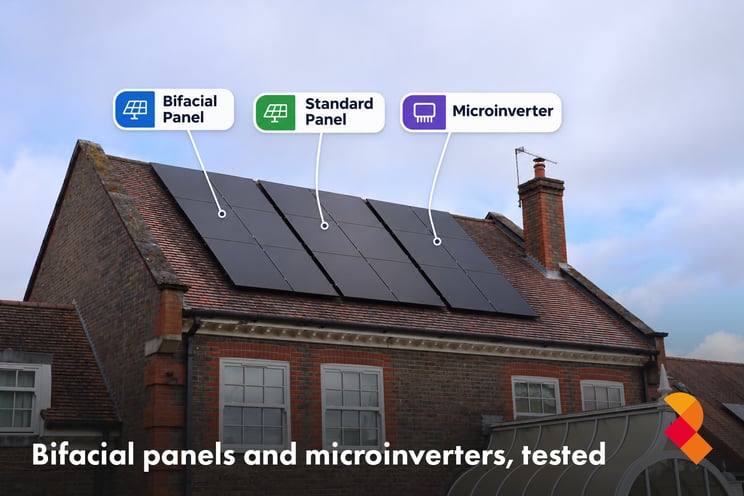
Microinverters usually cost £100 to £130 more per panel than a string inverter, and the best side-by-side test on an unshaded roof found they produced only about 0.5% more electricity. That test was run in 2011, so Spirit Energy and Gary Does Solar have built a new one on a real UK roof, with 24 LONGi panels split into three independently metered blocks. Over the coming years it will show whether microinverters earn their cost without shade, and whether bifacial panels generate anything extra from the back on an ordinary tiled roof.
Why test microinverters and bifacial panels on an unshaded roof?
Both are upgrades homeowners are offered when they get a solar quote, and both cost more than the standard option. For both, there’s very little independent, real-world data for the type of roof most UK homes have.
Microinverters are known to help on shaded roofs. Bifacial panels are known to help on ground mounts and carports, where plenty of light gets underneath. The open question is what either adds on a pitched tiled roof with no shade, because that’s where a lot of the money gets spent.
The answer will change what Spirit Energy recommends. If a feature adds nothing on a typical roof, there’s no reason to pay more for it. If it adds a few percent, that’s worth knowing, because a few percent adds up over 25 years.
What is a bifacial solar panel and how does it work?
A standard solar panel, also called a monofacial panel, has cells that face one way with a solid back behind them. A bifacial panel has a glass back, so light reaching the rear of the panel can also hit the cells and generate electricity.
That rear light has to come from somewhere. It’s mostly light bouncing off the surface underneath the panel, or coming in from the sides. How much bounces back depends on how reflective that surface is, which is known as albedo. Our guide to bifacial solar panels and the albedo effect explains this in more detail.
On a ground mount, a panel might sit a metre or more above gravel or grass, with lots of light getting underneath. On a pitched roof, the panel sits about 160 mm above the tiles, and the tiles beneath are mostly in the panel’s own shadow. Most roof arrays also have bird mesh around the edge, which blocks some of the light that could get in from the sides.
The test roof has bird mesh all the way round, so it reflects a normal installation. Some people say that makes bifacial panels a gimmick on a roof like this. Others say light from the sides, especially when the sun is low, will still add something. There’s very little measured data either way.
Are microinverters worth it on a roof with no shade?
On a standard system, panels are wired together in a line called a string. The electricity runs to one inverter, which converts it from DC into the AC your home uses. With microinverters, each panel has its own small inverter on the roof behind it, so every panel is converted to AC on its own.
That independence is why microinverters help with shade, because one shaded panel can’t drag down the rest of the array. Our solar panel shading analysis and our Knowledge Bank guide to micro-inverters and solar panel optimisers cover how that works.
Without shade, the case is much weaker on paper. The best side-by-side test we’ve found was run in 2011 by PV Evolution Labs in California, with the analysis carried out independently by America’s National Renewable Energy Laboratory (NREL). Two near-identical 8 kW arrays were compared, one on Enphase microinverters and one on a Fronius string inverter. Over four days with no shade, the microinverter array produced about 0.5% more.
Under shade the gap was much bigger. NREL estimated a 4% annual gain for a lightly shaded roof, 8% for moderate shade and around 12% for heavy shade. The test data was collected under an agreement with Enphase, though NREL developed the method and analysed the results.
To put the unshaded result in pounds, take an illustrative system generating 4,000 kWh a year. A 0.5% gain is 20 kWh. Even if every unit was worth 30p, that’s £6 a year, against an upfront premium of £100 to £130 a panel plus extra labour on the roof.
Inverters and panels have changed a lot since 2011, so the result today could be different in either direction. Microinverters also have other arguments in their favour, such as panel-level monitoring and no single inverter to fail. This test looks at one question only, which is how much electricity they produce.
How the 24-panel solar test is set up
Gary from Gary Does Solar brought the idea to Spirit Energy, and much of the thinking behind the design is his. The rule the whole test is built on is simple. If you want to know what difference something makes, it has to be the only thing that’s different.
If two systems have different panels and different inverters, and one makes more power, you can’t tell why. So each comparison on this roof changes just one thing. The roof has three blocks of eight panels, each with its own inverter and its own independent meter.
| Block | Panels | Inverter | Independent meter |
|---|---|---|---|
| Block 1 (left) | 8 × LONGi 480 W standard | SMA 3.6 kW string inverter | Acrel DC meter |
| Block 2 (middle) | 8 × LONGi 490 W bifacial | 8 × Enphase IQ8HC microinverters | Acrel AC meter |
| Block 3 (right) | 8 × LONGi 490 W bifacial | SMA 3.6 kW string inverter | Acrel DC and AC meters |
The bifacial test compares blocks 1 and 3. Both sit on the same roof at the same pitch, facing the same way, on identical inverters. The only difference is whether the panel is bifacial or monofacial.
The microinverter test compares blocks 2 and 3. Both use the same 490 W bifacial panels, so the only difference is the inverter.
How bifacial panel gain will be measured
The two panel types aren’t rated identically. The standard panels are 480 W and the bifacial panels are 490 W, so the bifacial block has 3.92 kWp of panels against 3.84 kWp. On total kWh alone, it would start about 2% ahead before the back of the panel had done anything.
To level that out, the comparison uses kWh per kWp. That’s how much electricity each block produces for every kilowatt of panel on the roof.
The bifacial test is measured on the DC side, which is the electricity coming straight off the panels before it reaches the inverter. That keeps inverter losses out of the comparison, so the result reflects what the panels themselves produce.
The test will run for decades, so the seasons will show up in the data. The sun sits much lower in winter, and that angle may suit the back of a bifacial panel better. If it gets homeowners a bit more power in the winter months, that’s worth knowing.
How the microinverter vs string inverter test will be measured
The microinverter test is measured on the AC side, after the electricity has been converted. That’s what actually reaches your home, and it’s where the difference between the two inverter types shows up.
One thing could count against the microinverters, and it’s part of how they’re designed rather than a flaw in the test. Each panel is rated at 490 W, but each Enphase IQ8HC has a maximum continuous output of 380 VA, which is roughly 380 W. On a bright day, the microinverter can cap the panel’s output. This is called clipping.
On an east-facing roof, clipping isn’t expected to happen often. When it does, it’s fair to count it against the microinverters, because it would happen on your roof too. The string inverter has more headroom by comparison, with 3.92 kWp of panels on a 3.6 kW inverter.
Why independent solar metering matters
The results won’t be taken from a manufacturer’s app. Every block is checked against independent meters from Acrel, which specialises in energy metering. Solis and Sungrow, two of the world’s largest inverter manufacturers, both supply Acrel meters with their own systems.
Measuring AC is the easier part. An AC meter uses a CT clamp, short for current transformer, which fits around the cable. AC flows back and forth 50 times a second, creating a changing magnetic field that the clamp can pick up.
DC flows steadily in one direction, so there’s no changing field for a clamp to read. A DC meter uses a shunt instead. That’s a precisely made piece of metal with a very small, known resistance, fitted in line with the cable. The current flowing through it creates a tiny voltage, and the meter reads that voltage to work out the current. It has to be carefully calibrated to give an accurate reading.
Why LONGi panels and Enphase and SMA inverters were chosen
Every panel, inverter and meter was chosen on quality and track record. Spirit Energy has been installing solar for 16 years and has completed more than 6,000 installations, which gives a good picture of which kit lasts and which doesn’t.
The panels come from LONGi’s premium back contact range. The standard panels are the Hi-MO X10 and the bifacial panels are the Hi-MO S10. In a back contact panel, all the electrical connections sit on the back of the cell, leaving more of the front free to catch light. The S10 was one of our top two picks in our guide to the best solar panels of 2026.
Enphase has long been the default for microinverters, and if you have microinverters on a UK roof there’s a good chance they’re Enphase. Newer brands look promising, but a solar system is a 25-year investment and this test needs to still be running in a decade. The IQ8HC is one of Enphase’s most recent models, and it’s the one Enphase recommended for this test. Our earlier comparison of SolarEdge optimisers vs Enphase micro-inverters covers the brand in more depth.
The string inverters were originally going to be Fronius, but Fronius couldn’t deliver them in time, so the test uses two identical SMA inverters. SMA is a German manufacturer and one of the most established names in solar. Spirit Energy used SMA inverters when it started in 2010, and many of those are still working today, well beyond their expected 10-year lifespan. You can read more in our Knowledge Bank guide to SMA solar inverters.
What this solar test can and can’t tell you
No test like this is perfect. Two panels of the same model aren’t quite identical, and LONGi rates its panels with a positive tolerance. Each should produce at least its rated output, and possibly a little more. Across eight panels those differences should even out, but a gap of a fraction of a percent won’t be treated as meaningful.
The roof surface matters too. Light-coloured surfaces reflect more light onto the back of a panel than dark ones, and some people paint their roofs white for exactly that reason. These tiles are grey, so the bifacial result won’t exactly match a roof with lighter or darker tiles.
This is also one east-facing tiled roof. It won’t tell you how bifacial panels perform on a ground mount or a carport, where they’d reasonably be expected to do much better.
When will the bifacial and microinverter results be published?
The plan is to take an early look at the data after about three months, then again at six months and a year. Results will keep being published well beyond that.
Until the data is in, the advice stays the same. Put the money where it makes the biggest difference to your return, which our solar return on investment guide in the Knowledge Bank explains in detail. Spirit Energy’s bespoke technical quotations include forecast generation, so you can see what an upgrade is expected to add before you pay for it.