


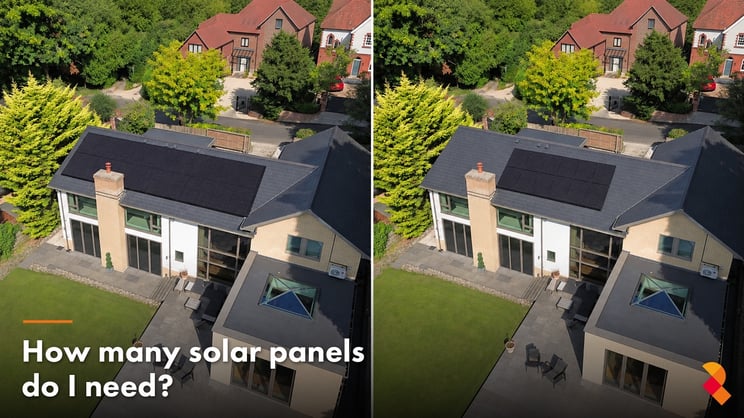
For most UK homes, the number of solar panels you need is set by the size of your roof, not your electricity bill. Scaffolding, the inverter, the battery and the labour cost roughly the same whether you fit 10 panels or 20, so each extra panel adds little more than its own price. When Spirit Energy ran the same house through its solar calculator with 16 panels and then 24, the bigger system cost about £2,000 more but is forecast to save £488 more in its first year and £20,500 more over 25 years.
Why your roof sets the limit, not your bill
A solar and battery system usually costs at least £10,000 and should stay on your roof for 25 years or more. Once the scaffold comes down, the number of panels is more or less fixed.
The panels are one of the cheaper parts of that bill. Most of the money goes on the battery, the inverter, the scaffolding, the electrical work, and the people who design, fit and look after the system. In our guide to the most common solar and battery mistakes, we put the panels at around 5 to 10% of the total job cost.
That’s why package deals, where you pick a 4 kWp or 6 kWp system for a set price, tend to leave money on the roof. They don’t account for how big your roof is, which way it faces or how much electricity you use.
It also pays to get the size right first time. Adding more panels later means paying for scaffolding all over again.
How much is one extra solar panel worth?
Spirit Energy’s modelling shows a standard 495W panel on a south-facing roof in Reading should generate about 487 kWh in its first year. What that’s worth depends on whether you use the electricity or export it.
- Used in your home. At 28p a unit, it saves you £136.36 a year.
- Exported to the grid. At 12p a unit, it earns you £58.44 a year.
- At the new price cap. Ofgem’s rate of 32.69p a unit applies from 1 January 2027. At that rate, the same panel is worth £159.20 a year if you use all of it.
Most panels land somewhere in between, depending on how much of their output you use at home. Our post on what rising electricity prices mean for solar owners explains why a higher unit rate improves the return on every panel you’ve fitted.
Why sizing solar to your yearly usage leaves you short in winter
The usual advice is to match the system to your bill. If you use 3,500 kWh a year, you buy a system that makes 3,500 kWh a year, and on paper the numbers match.
In practice, solar makes most of its electricity in summer, while most homes use more in winter. When we modelled a 6 kWp system for our EV charging video, it was forecast to export 20.73 kWh on an average summer day and just 3.59 kWh on an average winter day. A system sized to your annual total exports heavily in June and still leaves you buying most of your electricity in December.
Every extra panel adds a bit more generation in the months you need it most, and the money reflects that. In our calculator comparison, using the same battery and tariff for both, 24 panels (about 12 kWp) cost about £2,000 more than 16 panels (about 8 kWp). Both are forecast to pay for themselves in about eight years, but the investment return on the larger system works out at 15.1%, against 13.1% for the smaller one.
How many solar panels can your roof take?
Start with which parts of the roof are worth covering. South is best, but east and west aren’t far behind. In our modelling, an east or west roof generates about 80% of what a south roof does over a year, so both are usually worth filling. A north roof makes about 55%, which doesn’t rule it out but means it needs its own sums (see below, and our post on north-facing solar panels).
Use the solar calculator
On the roof and panels tab of the Spirit Energy solar calculator, you can model the roof itself rather than guess a panel count. If you already know how many panels fit, you can enter that instead.
Measure it at the kitchen table
Open Google Maps or Google Earth, switch to satellite view and use the measuring tool. Satellite images can make buildings look as if they’re leaning, so measure the full length of the house and take the midpoint to find the apex, assuming the roof is symmetrical. That’s more accurate than trusting where the ridge appears on screen. Architectural plans are better still, as they’ll be accurate to the centimetre.
From above, you’re seeing the roof flattened, so the slope from gutter to ridge is longer than it looks. On a 35° roof, 4 m on the satellite image is closer to 4.9 m up the slope. You can work it out with a little trigonometry or treat your number as a rough one.
Leave a border of about 0.4 m around every edge, then count each panel as roughly 1.8 m by 1.15 m, the size of a standard 495W panel such as the LONGi Hi-MO X10. It won’t be exact, but it will tell you whether your roof takes 10 panels or 12. Our step-by-step guide to measuring your roof covers plans, site surveys and drone surveys in more detail.
Get a design built around your roof
An installer’s design does the same job properly, fitting panels around chimneys, vents and rooflights and giving you a layout, a kWp figure and a generation forecast.
Compare solar quotes on kWp, not panel count
Kilowatt peak (kWp) is what your panels add up to on paper, and it matters more than how many panels there are. Sometimes fewer, bigger panels give you more.
In our jumbo panels video, one roof could fit 21 standard 470W panels, which is 9.87 kWp. The same roof could fit 16 jumbo 625W panels, which is 10 kWp. Fewer panels made more power and needed less mounting kit to hold them on.
More kWp from the same roof means a better investment return, so if larger panels get more out of your roof, ask your installer about them.
How much electricity will your solar panels generate?
Multiply your kWp by how much each kWp generates in a year where you live. Spirit Energy’s modelling uses irradiance data for RG30 in Reading, at 51.5° north and 1.02° west, and gives these yields per kWp each year.
- South-facing roof. A south roof like our office building makes 984 kWh.
- East or west-facing roof. An east or west roof makes 783 kWh.
- North-facing roof. A north roof makes about 540 kWh.
The figures are a little lower the further north you live, and the solar calculator works them out for your postcode.
As a worked example, 16 panels at 495W is 7.92 kWp. On a south roof in Reading, that’s 7.92 multiplied by 984, or about 7,793 kWh a year. If you have more than one roof face, work each one out separately and add them together.
Modelling is only useful if it holds up. One Spirit Energy customer’s system was forecast to generate 7,320 kWh in its first year and actually produced 7,430 kWh, 1.5% above the prediction.
When filling the roof isn’t the right call
There are three situations where we’d check the numbers carefully before covering every roof face.
A north roof that needs its own scaffold
Eight 495W panels on a north roof in Reading should generate about 2,140 kWh a year. If every unit were exported at 12p, that’s about £257 a year. If the north roof shares a scaffold with the south roof, the sums often work. If it needs its own, ask your installer what that roof adds to the price and divide it by £257. That gives you the payback on those panels in the worst case, and the decision is yours.
Heavy shade
A panel that sits in shadow for half the day doesn’t pull its weight. You may be offered optimisers or microinverters, small boxes fitted behind each panel so a shaded one doesn’t drag the others down. They help, but they can’t remove the shade, and very often the better answer is to leave that panel off. Our post on how shading affects solar panels explains when they earn their cost.
A very large roof
Exporting isn’t the problem on its own. Even a panel that exports everything it makes still earns about £58 a year, so it pays for itself if it’s cheap to add. The problem comes when the next panel stops being cheap.
Past a certain size you’ll need a bigger inverter, the box that turns your panels’ power into electricity your home can use, and that’s a big jump in cost. Your DNO, the company that runs your local electricity network, can also cap how much you’re allowed to export, and past that cap the extra power on a sunny day can go to waste. On a big roof, ask your installer to show you where those points sit for your house.
If you’re weighing up a battery as well, how much battery storage should you get? works through the same kind of sums. Spirit Energy has designed every one of its 6,000+ installations since 2010 around the roof in front of it.